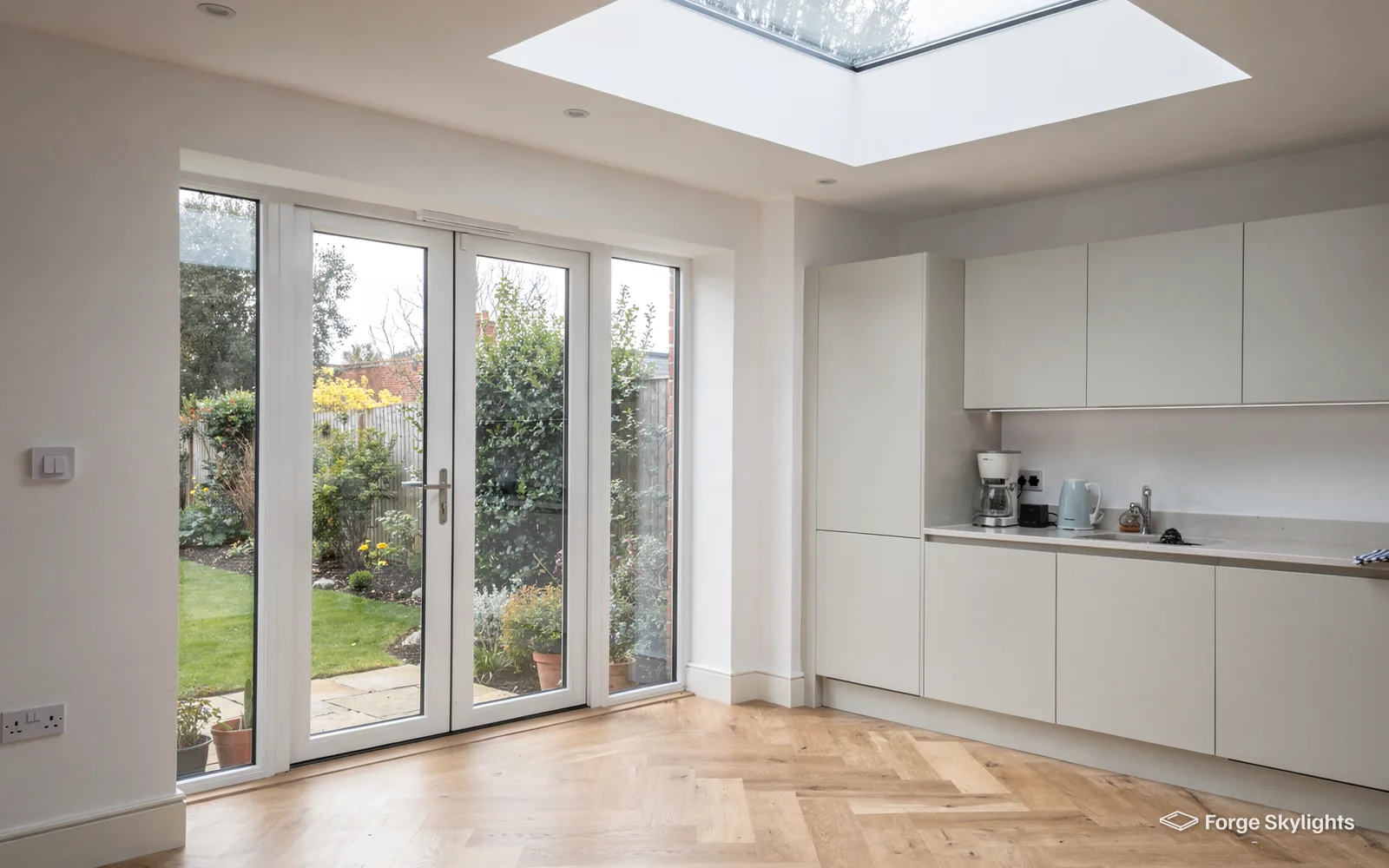
Which one do you need to reach?
The question that settles most choices is simple: can you reach the rooflight comfortably from the floor? If the sash sits within a pole's length of where you stand, a manual opener will work it. If it is high above a stair void, a kitchen island or a double height extension, a motor starts to look like the sensible option, because a pole that long is awkward and a ladder is worse.
Manual rooflights open by a handle, a winder or a telescopic pole that hooks into an eye on the sash. Electric ones open by a motor, worked from a switch, a remote or a pad. Both give the same ventilation once open, and both can be had in fixed-frame, flat roof and pitched roof forms. What changes is how you get the sash from shut to open, and how much the choice costs you in money, wiring and upkeep.
A rooflight is a skylight with a vent in it, and the vent is the whole point of choosing an opening one. Warm air collects at the highest point of a room, so a vent up there lets it escape while cooler air comes in at a door or window below. Which opener works that vent matters far less than where the vent sits and whether you will actually use it.
Our hub page on electric and opening rooflights sets out every way a rooflight can open. This guide takes the two ends of that range, the pole and the motor, and puts them next to each other on the measures that people ask about.
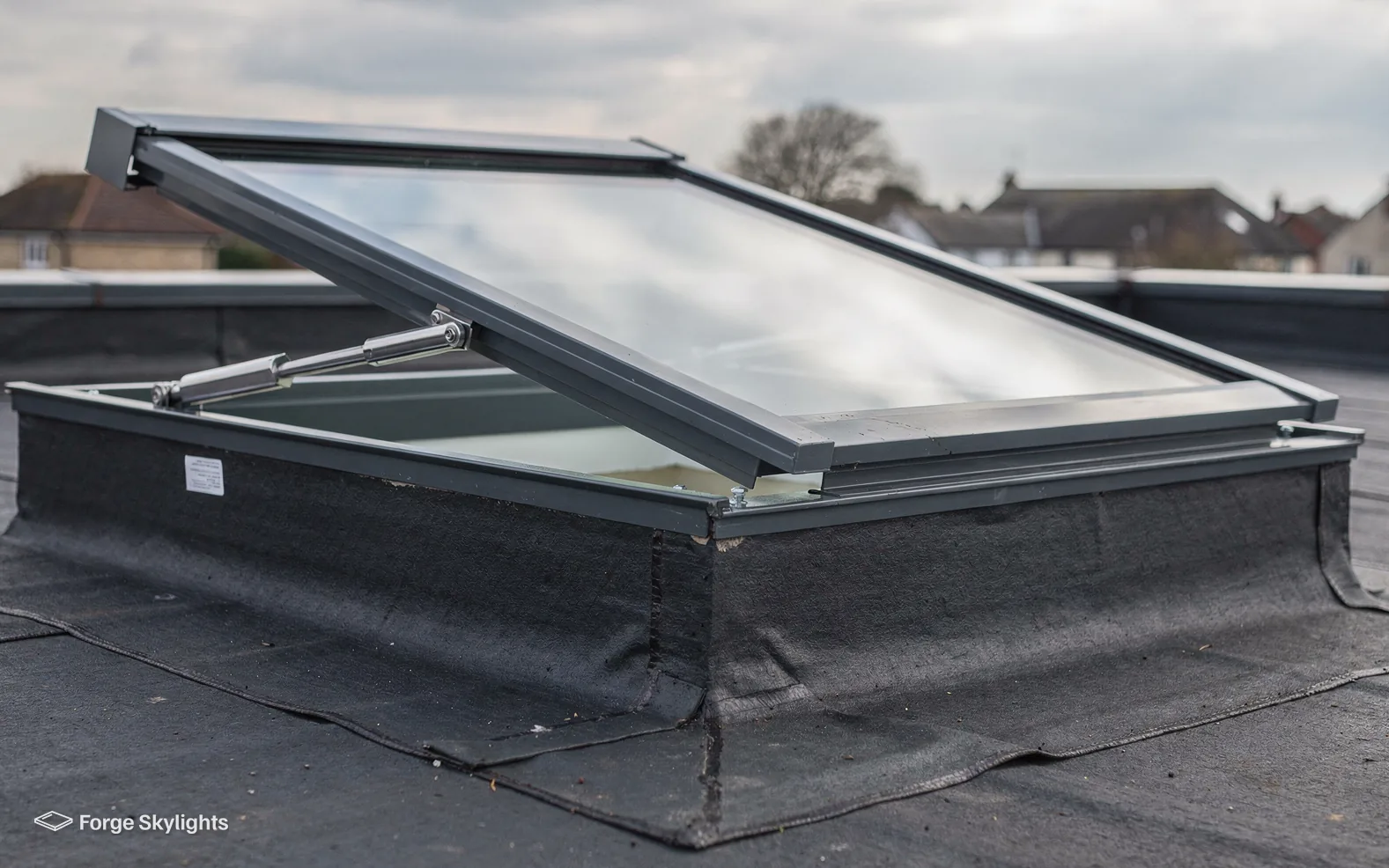
The two compared, measure by measure
The table below holds the two openers up against the same questions. Values are relative, since the exact figures depend on the maker, the size and the roof, and each is shown on your written quote.
| Item | Manual | Electric |
|---|---|---|
| Worked by | Pole, handle or winder | Switch, remote or wall pad |
| Reach | Within arm or pole length | Any height |
| Power needed | None | A cable to the unit, or a built-in solar panel |
| Rain closing | By hand, when you notice | Automatic with a rain sensor |
| Controls | Nothing to set up | Pads, receivers or an app to set up |
| Upkeep | A drop of the maker's lubricant on the moving parts now and then | The same, plus checks on the motor, sensor and battery |
| Price | Lower | Higher, with the wiring or solar panel on top |
| Best for | Rooms where you can reach it | High rooflights, groups of vents, busy households |
Neither column wins every row. Manual units win on cost, simplicity and independence from the electrics. Electric units win on reach and on shutting themselves in the rain. Where the table leaves you unsure, the next chapters take each measure in turn.
One thing the table cannot show is how the two feel in daily use. A pole opener is a small chore, done in a few seconds, and it becomes a habit in rooms you use. An electric opener is closer to a light switch, which makes it far more likely to be used in a room where the rooflight is out of reach.
Reach and where the rooflight sits
Reach is the clearest dividing line. A pole adds a modest extension to your arm, and a handle or winder needs you to stand under the rooflight. On a flat roof over a kitchen extension with a standard ceiling, that is usually fine. Over a stair, a mezzanine or a vaulted room, the sash can sit well out of reach of anyone on the floor.
Pitched roofs bring their own geometry. A roof window set low in a sloping ceiling can be worked from a bed or a desk, but one at the top of the slope may need a pole at full stretch. Our guide to roof access rooflights covers the hatches that open wide enough to climb through, which are a separate case with their own hinges and stays.
We take the measurements at the survey: the ceiling height, the position of the rooflight above the floor and where you will stand when you use it. If the answer is that you can reach it, we say so, and a manual unit saves you money. If you cannot, we show the electric version next to it so you see what the extra reach costs.
Reach also covers people. A household with someone who finds a pole difficult, or who would like to work the vent from a chair, has a good case for a motor even in a low room. A remote that sits in a hand or on a table is far easier than a hooked pole, and it can be kept where it is needed.
Rain, weather and what happens when you are out
A manual rooflight closes only when someone closes it. If you leave a vent open and go out, a shower can come in. Shutting it on the way out soon becomes a habit, but it still relies on that habit and a bit of luck with the forecast.
An electric unit with a rain sensor shuts itself when moisture lands on the pad. Our answer on how a rooflight rain sensor works explains what the sensor does and where it gives ground, since it reacts to rain on the glass and is not a guarantee against every storm. It is the biggest practical gain of an electric rooflight, and the reason it is the sensible choice in a room you leave open all day.
The same sensor makes electric units more comfortable to leave on a warm day when no one is home. A pet, a sleeping baby or a loft office that gets hot while you are at work are all easier to manage with a vent that looks after itself. Wind and heat inputs are available on some systems, and each adds to the cost and the setup.
A power cut
An electric rooflight that loses power stays where it is, open or shut. Some units can be moved by hand with a manual release or a key, which the maker describes in the handbook. Our page on electric rooflights in a power cut covers what to check before you buy.
Power, wiring and the work in the room
A manual rooflight asks nothing from the building beyond a sound opening and a fixed frame. There is no cable, no transformer and no control to place. That makes it the easiest to fit in an existing room with a finished ceiling, and the easiest to replace later.
An electric rooflight needs either a cable to the unit or a solar panel in the frame. The cable is the part that surprises people, because it is not the motor that costs the most but the route for the cable through a finished house. Our guide to wiring an electric rooflight sets mains and solar units side by side and shows what to plan before the ceiling is closed.
If the room is being built or the ceiling is open, the extra work is small and the cost is mostly the motor and the control. If the ceiling is finished and painted, a solar unit can avoid the cable, though it costs more in the unit itself and relies on the light the panel sees.
A kitchen extension, with the rooflight over the island
Manual with a pole
- Reach from the floor
- Comfortable if the ceiling is standard height
- Work in the ceiling
- None
- Closing in rain
- By hand
- Cost
- Lowest of the two
A good fit for a low, simple room.
Electric with a sensor
- Reach from the floor
- No need to reach at all
- Work in the ceiling
- A cable run or a solar panel
- Closing in rain
- Sensor shuts it for you
- Cost
- Higher, with the control and wiring
A good fit for a tall room or one left open while you are out.
Neither option is wrong for this room. The pole suits a low ceiling and a household that likes things simple. The motor suits a taller room, a busy house and anyone who would rather not think about the weather.
Upkeep and how long each one lasts
Manual openers are about as simple as a mechanism gets. A hinge, a stay and a locking handle will keep working for many years with a little care, and when a part wears the replacement is usually small and local. The pole itself is cheap and easy to replace.
Electric openers have more to look after: a motor, a receiver, a sensor, and for solar units a battery that will need replacing eventually. A good unit is built for many cycles, and the maker states the warranty on the motor and the glass. Our guarantee covers our workmanship for 10 years, and the maker's own warranty sits on top of that for the unit.
Whichever you choose, keep the seals clean and the moving parts free. A rooflight that sticks can simply have dirt in the channel, which a soft brush and a wipe will clear. The handbook lists what the maker recommends for the moving parts, and we pass it on with your quote.
Maintenance is also where the electric unit gives a little ground. If a motor fails, the vent stays where it stopped, and you need the maker's part or a fitter. A manual unit can be closed by hand any time. In a room with an important vent, such as a bathroom or a utility room, it is worth asking at the survey how each option behaves when something stops working.
Price: what the motor adds
A manual rooflight is the lower price of the two, and an electric one adds the motor, the control, the sensor and the electrical work. How much that adds depends on the unit and on how hard the wiring is, so we price each part on its own line after the survey. Our answer on what an electric rooflight costs lists the parts that make up the difference.
It helps to see the extra as a price for three things: reach, rain closing and convenience. If the rooflight is already within reach and you shut windows as a habit, the extra buys you little. If the rooflight is out of reach or the house is often empty, it buys a lot.
A fair way to decide is to ask for both on the same quote. Both a manual and an electric version of the same rooflight go onto the quote together, with a spread of makers where the roof allows it, and glazing, frame, lead time and price run down matching columns. You then see the exact cost of the motor and decide whether it is worth it for that room.
Choosing, and what happens next
A rule of thumb helps when the choice is close. Pick manual where the rooflight is in reach, the ceiling is finished and the budget is tight. Pick electric where the rooflight is out of reach, the room is built or open, or the vent will often be left open when no one is home. Mixed answers are common, and a house with a low landing rooflight and a high kitchen one may use one of each.
Free survey
We measure the opening, the ceiling height and the reach, and look at the roof and the cable route.
Options side by side
A written quote with manual and electric versions set out on the same rows.
You choose
The opener, the controls and the sensor that suit the room.
Fitted and checked
Built to current Building Regulations, with Building Control notified where the work is notifiable, and tested before we leave.
A new opening cut through a roof is classed as building work, and swapping a whole rooflight must be notified. Permission turns on your address, which is why our rooflight planning guide explains how permitted development works, and the position for your house is something we check ourselves. The council decides.
Whenever suits you, book a free survey and both versions will be priced for your room, one beside the other.
Common questions
Can I swap a manual rooflight for an electric one later?
Sometimes, where the maker sells a motor kit for the same frame. Otherwise the whole rooflight is replaced, which is notifiable work, and we check which route suits your unit at the survey.
Do electric rooflights open wider than manual ones?
Not as a rule. The opening angle is set by the hinge and the stay, and both kinds are built to similar limits. What differs is the reach and the control.
Is a manual rooflight safe to leave open overnight?
Many have a restrictor or a locking stay that holds the sash at a small gap. Ask for the version with a night latch, and we list the security features of each unit on your quote.
Which is easier for an older person to use?
A remote or wall pad is usually easier than a pole, since it needs no reach and no force. We can show you the controls at the survey so you can try them.
Will an electric rooflight work if my Wi-Fi is down?
Switch and remote controls do not use your Wi-Fi, so they carry on as normal. Only app controls and smart home links rely on it, and any manual release on the unit works whatever the network does.