Electric and opening rooflight installation in Birmingham
Every opening option, side by side.
Hand-wound, electric and solar opening rooflights for Birmingham homes, compared on reach, controls, rain closing and power in one written quote. Free survey.
- 10-year workmanship guarantee
- Fitted to current Building Regulations
- Building Control notification handled
- Free survey and written quote
- Not tied to one manufacturer
Choosing an opening rooflight
Can I reach it to open it?
We measure the height and the reach before we suggest a pole, a switch or a remote.
What happens if it rains while I am out?
A rain sensor closes the vent on its own, and the quote says which units carry one.
Where does the power come from?
We trace a route for the cable at the survey, or price a solar unit with no cable at all.
The long read
Electric and opening rooflights in Birmingham, compared
An opening rooflight lets the hottest air out of a room at its highest point. This read sets the ways of opening one side by side, from a pole to a motor, so you choose the controls as well as the glass.
What an opening rooflight does for a room
- Fixed
- Opening
- Access
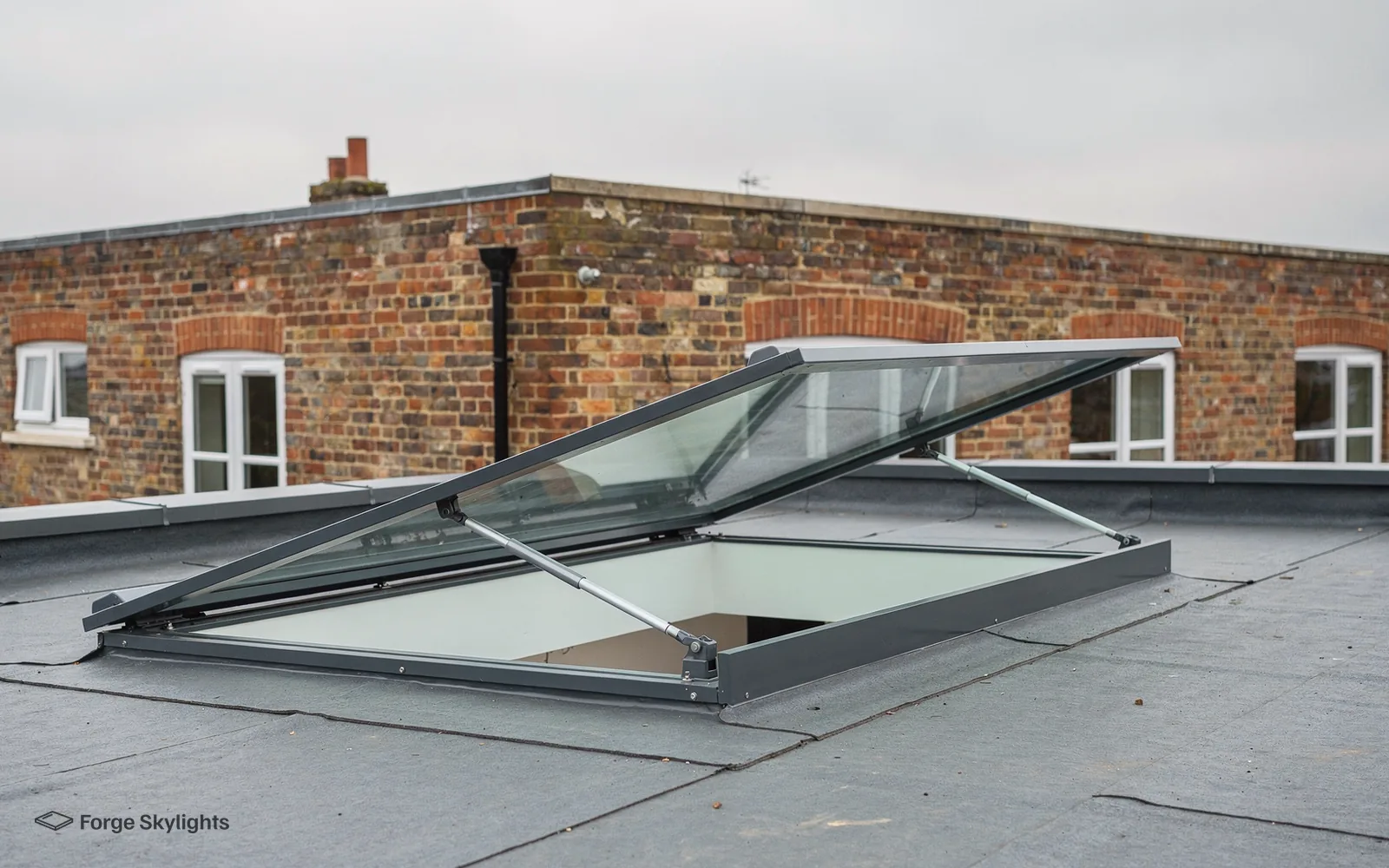
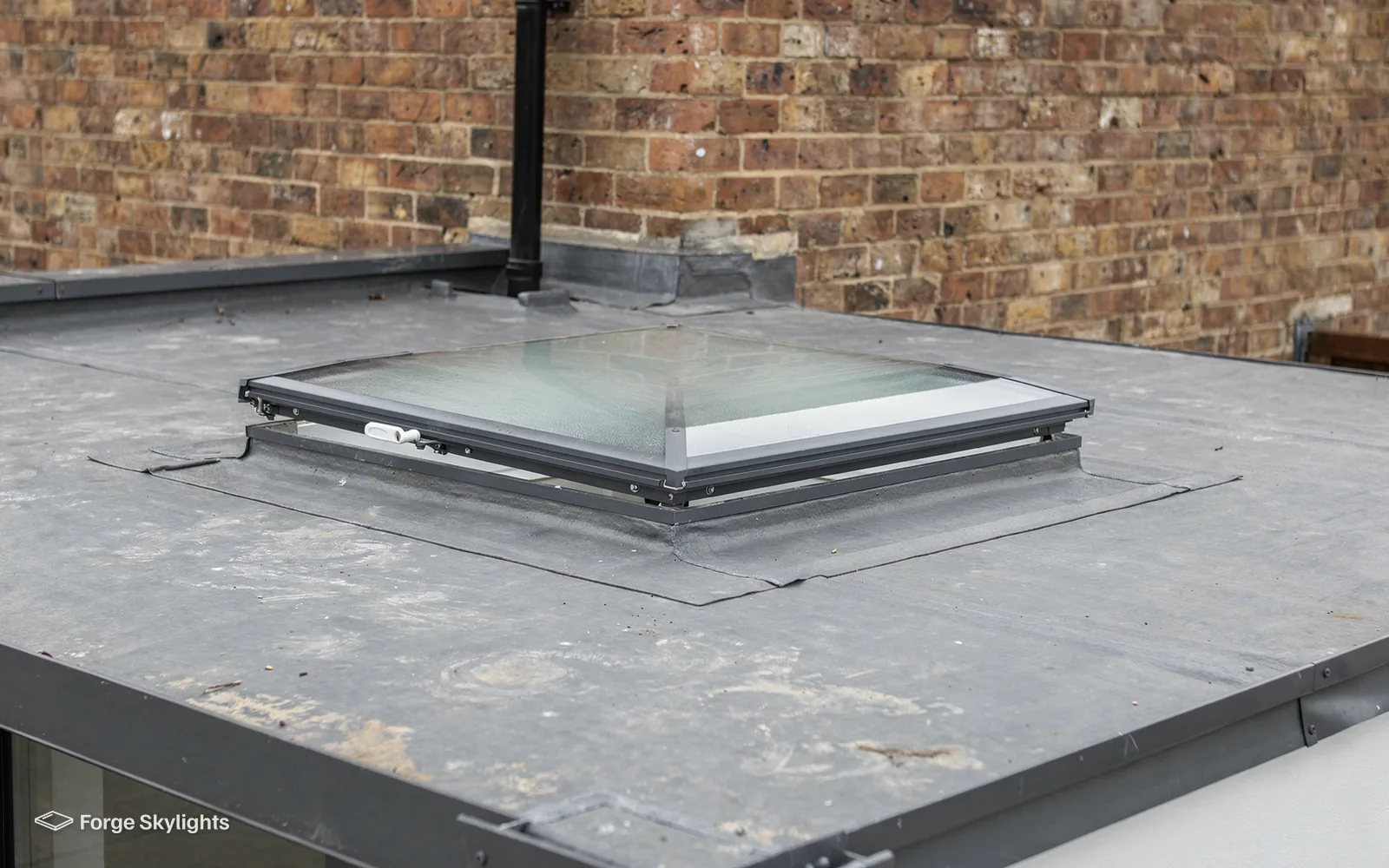
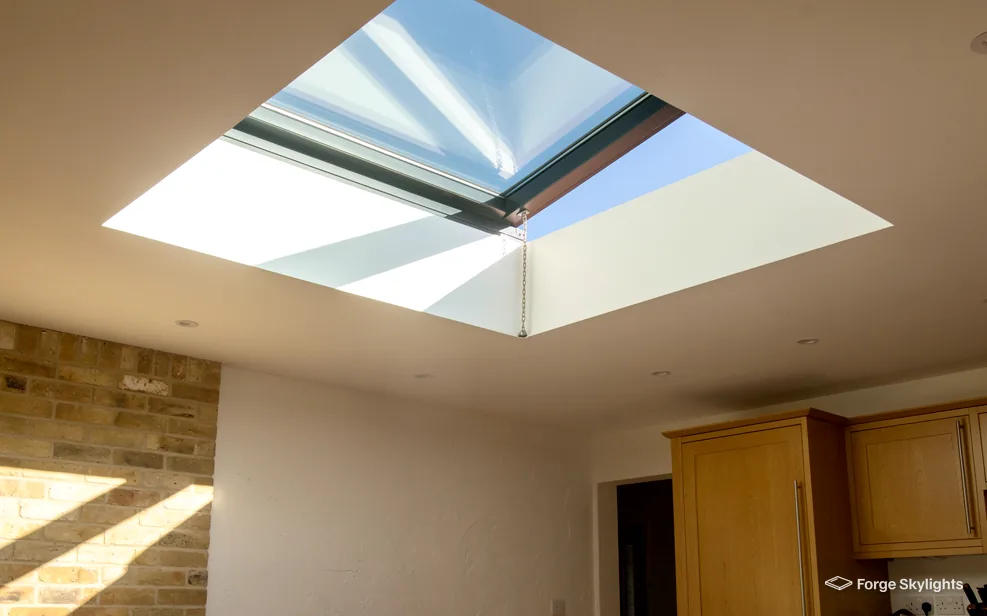
An opening skylight is a rooflight with a hinged or sliding sash, so the glass lifts clear of the frame and the room can breathe through the roof. Warm air collects under the ceiling, and a vent at the top lets it leave while cooler air comes in lower down at a window or door.
Some are made only for ventilation. Others are made for access, with a sash big enough to climb through to a flat roof. Whichever you need, the sash can be turned by hand or driven by a motor.
Which one suits you depends on the room below, the height of the ceiling and whether anyone needs to reach the roof.
Asked by a homeowner
Does an opening rooflight let the rain in?
Not when it is closed, and a rain sensor can close it for you. Our answer on how a rain sensor works sets out what to check.
When opening is worth having
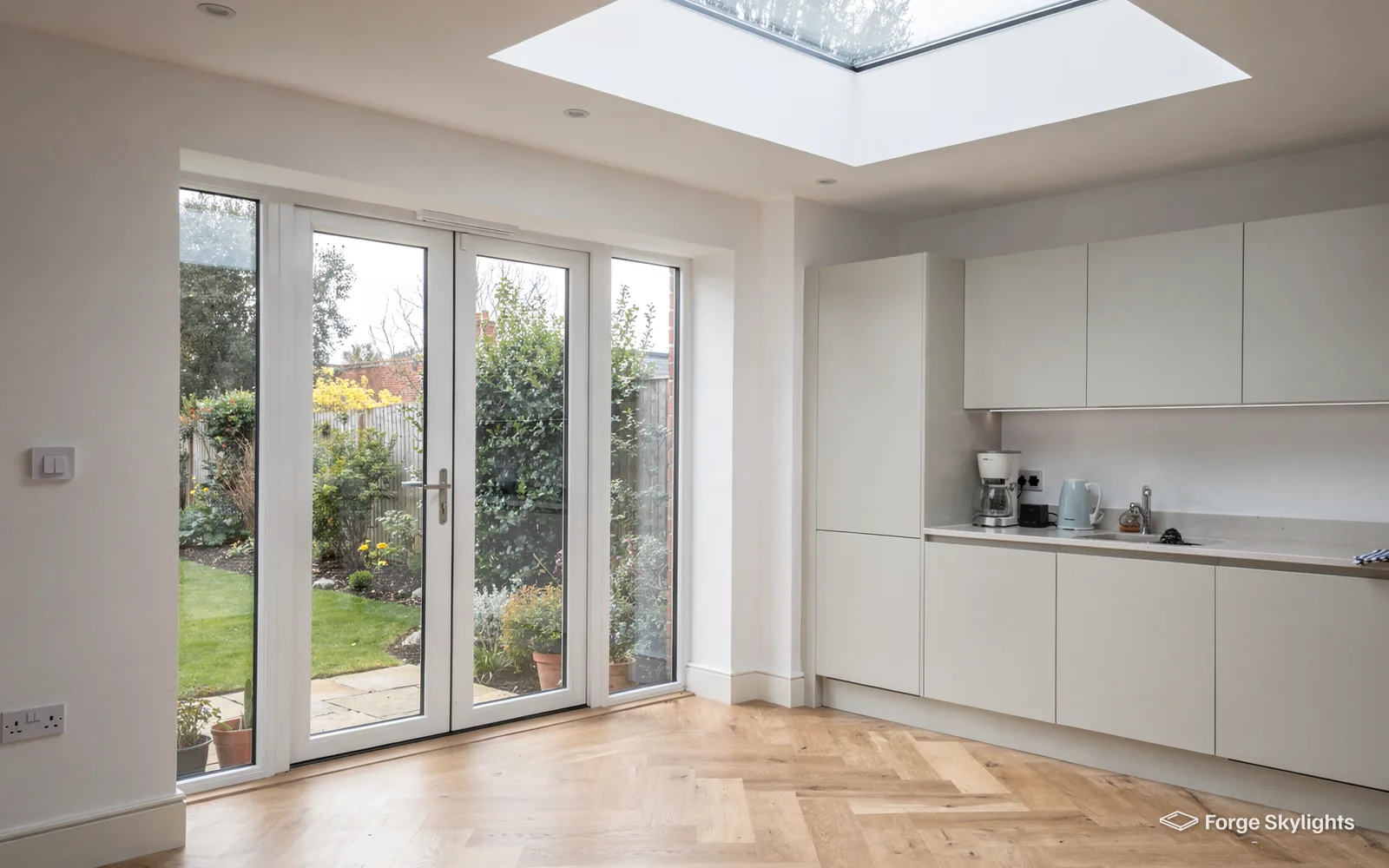
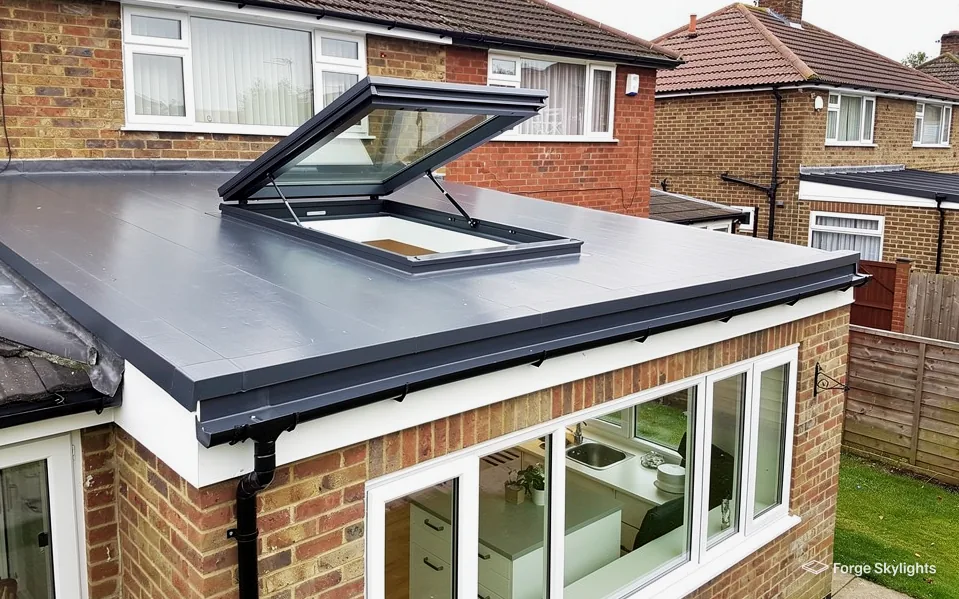
A fixed rooflight is simpler and usually costs less, and in many rooms it is all you need. An opening one earns its place where heat builds up, where steam or cooking smells linger, or where the room has no window high enough to move air. A kitchen extension with a flat roof and a wall of glazed doors is the classic case, because the sun heats the room from above and the doors only move air at floor level.
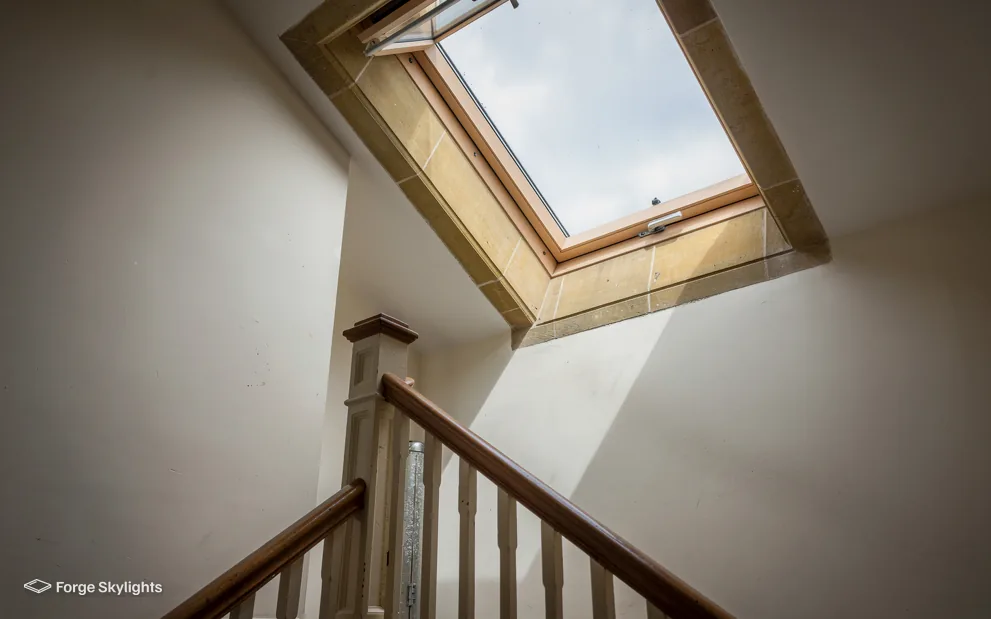
Loft rooms and landings are another. A stair landing under a roof window can run hot in summer, and a rooflight you can open at the top is the quickest way to draw that air up and out. Our page on roof windows compares the pitched-roof versions, and our page on flat roof rooflights covers the fixed units that sit beside them.
A room that already has good cross-ventilation may gain very little. At the survey we tell you if that is the case, and the quote can price a fixed unit and an opening unit for the same opening, which shows the extra cost of the opening on its own line.
Position matters as much as the opener. A vent at the high side of a mono-pitch roof lets warm air escape at the very top, while a vent placed lower in the room moves less air for the same opening. The fall of the roof, the position of the doors and windows and the direction the prevailing breeze tends to take across your garden all feed into where we suggest the vent goes, so it has the best chance of drawing air through the room.
Manual, mains electric or solar powered
- Manual
- Mains
- Solar
The three ways of opening, on the same measures
Manual
- Worked by
- Pole, handle or winder
- Power
- None
- Reach
- Within arm or pole
- Rain closing
- By hand
- Price
- Lowest
Simple, quiet and with nothing to fail electrically.
Mains electric
- Worked by
- Wall switch or remote
- Power
- Cable from the house supply
- Reach
- Any height
- Rain closing
- Sensor available
- Price
- Higher
The usual choice where a rooflight is out of reach.
Solar powered
- Worked by
- Remote or wall pad
- Power
- Built-in solar panel
- Reach
- Any height
- Rain closing
- Sensor included on many
- Price
- Highest
No cable to the unit, so no chasing into a finished ceiling.
How the three differ in daily use
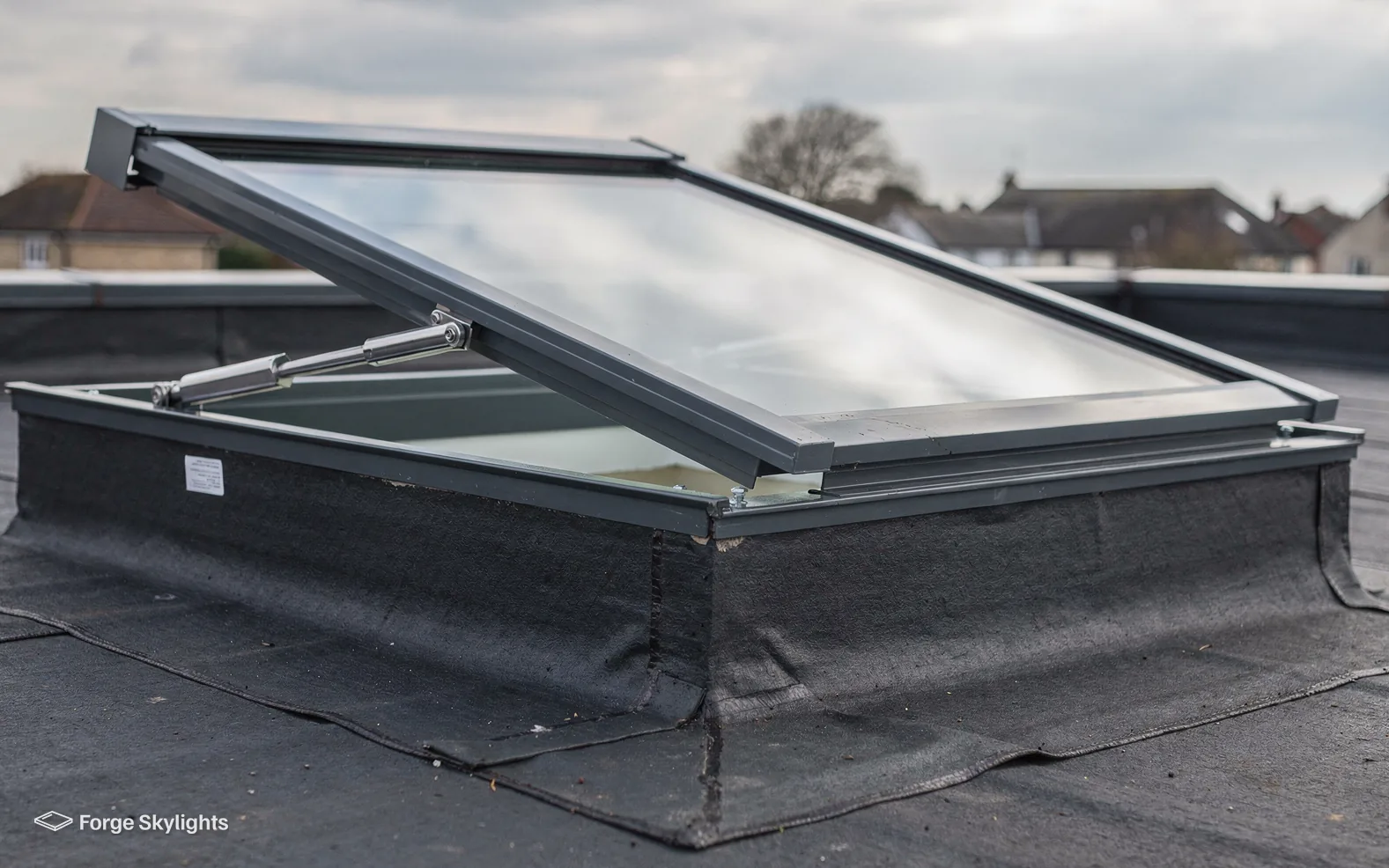
A manual rooflight is the one you can understand at a glance: you turn a handle or lift it with a pole, and it stays where you leave it. There is nothing to wire and nothing to run flat.
A mains unit opens at the press of a switch, so it suits a roof high above a stair, a double-height kitchen or a bathroom where wet hands and a pole do not mix. A solar unit does the same job with a small panel in the frame feeding a battery, which makes it a strong candidate in an existing room with a finished ceiling.
Comparing them fairly
Our guide to manual or electric opening rooflights runs through the two on reach, controls, rain closing, power needs, upkeep and price. Broadly, the manual unit costs least and the electric one is easiest to live with, with the solar version sitting where a cable would be awkward.
Makers differ in what their solar units include. VELUX, for example, makes a solar powered roof window with a rain sensor built in, and other makers offer solar options on flat rooflights. We read the specification sheet for each unit on the quote and put the facts in the same rows, so you are not comparing a brochure headline with a data sheet.
Upkeep differs a little between the three. A manual unit asks only for a wipe of the glass and a check of the seals. A mains unit adds a motor that should be run through its travel now and then. A solar unit adds a panel that wants a clear view of the sky, so a roof shaded by a large tree or a taller neighbouring wall may suit mains power better. Shading is noted during the survey, and where it changes the recommendation the quote states it.
Switch, remote, app or home system
- Switch
- Remote
- Smart
| Item | Wall switch | Handheld remote | Smart home link |
|---|---|---|---|
| Where it lives | Fixed to the wall | In your hand or a drawer | On your phone or hub |
| Wiring | A cable run to the switch | None at the wall | A compatible control unit |
| Several rooflights together | Possible on one switch | Often on one channel | Groups and scenes |
| Works with rain sensor | Yes, sensor overrides | Yes, sensor overrides | Yes, plus alerts |
| Price | Lowest | Middle | Highest |
A wall switch is the most familiar option and the easiest to explain to a visitor. It sits at the door or by the stair and does one job. A handheld remote avoids chasing a cable into a finished wall, which matters in a room that has just been decorated.
A smart home link adds scheduling, so a rooflight can open at the warmest part of the afternoon and close at night. Control kits differ by maker, and not every unit pairs with every hub, so we confirm the pairing in writing before you order.
Asked over the kitchen table
Can I add a second rooflight to the same remote?
Usually, if the units come from the same maker's control family. We note which controls each unit uses, so a later extension to the roof does not leave you with two handsets.
Where the controls go
Think about where you will stand when you want the room to cool down. A switch by the kitchen door is natural, while a switch behind the island is awkward. In a bedroom, a bedside remote is easier than a pad on the far wall.
We mark the control position on a sketch at the survey and agree it with you, so the cable run or the remote bracket goes where you will use it. Children and visitors also matter: a wall pad set high keeps small hands from opening a rooflight over a stair.
Rain sensors, safety and power cuts
- Rain
- Power cut
- Safety
How a rain sensor behaves
A rain sensor is a small plate on the glass or the frame that detects moisture and tells the motor to close the sash. It will usually override a vent that you opened earlier in the day, which is the point: you leave for work with the rooflight open, it starts to rain, and the vent closes.
Sensors need a clear surface. Leaves, bird droppings and dust can slow a response, so the plate is something to wipe when you clean the glass. Our answer on rooflight rain sensors covers what to check on the specification, including whether a manual unit can be given one later.
Some makers include the sensor as standard on the electric version, while others sell it as an extra. The quote shows which applies to each unit, so the line you read is the line you pay for.
- Sensor included or added, on the quote
- What the unit does when the power fails
- Where the control sits and who can reach it
What each type does when the power fails
Manual
- Affected by a cut
- No
- Position held
- Where you left it
- To close it
- Wind or pole as normal
Mains with back-up
- Affected by a cut
- Yes, unless backed up
- Position held
- Where it stopped
- To close it
- Back-up battery, or by hand
Solar
- Affected by a cut
- No, runs on its own cell
- Position held
- Where it stopped
- To close it
- Remote as normal
Power cuts, plainly
A mains rooflight without a back-up battery stays where it was when the power drops. If it was open, you close it by hand where the maker supplies a manual release. Our answer on an electric rooflight in a power cut explains the release for each type, so you can choose a unit with the behaviour you want.
Safety around a motor
Many electric openers are designed to stop when they meet resistance, so a hand or a branch in the gap is not trapped. We check whether the maker's data sheet states it for each unit on the quote. We also look at where a person might stand under the sash when it closes, which matters most over a stair or a bath.
Wind is the other thing a roof sees. An open sash catches the breeze, so makers limit how far a vent opens on some models and build the hinge and the actuator to hold it. On a roof that sits high and exposed, we check the maker's guidance on wind before suggesting a large sash, and a wind sensor is available as a control option on some systems.
Wiring, cables and who does what
- Mains
- Solar
- Routing
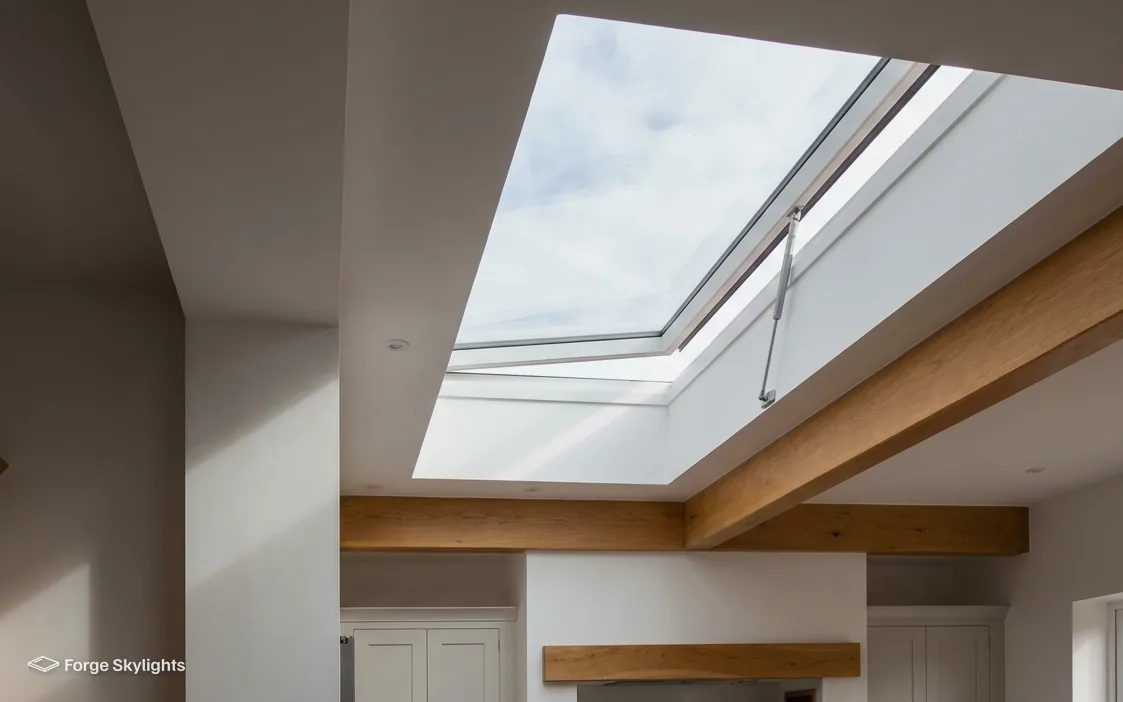
Planning the cable before the ceiling is finished
The easiest moment to run a cable to a rooflight is while the ceiling is open. A new extension or a re-roof gives us a clear view of the joists, so the cable can be threaded to the opening and left ready. In a finished room, the route is harder, and a solar unit or a remote-controlled one can save a lot of disruption.
Our guide to wiring an electric rooflight goes through the power supply, the switch or remote and the sensor, and what to agree before the plasterer comes. At the survey we mark the route and note any joists, pipes or insulation in the way.
The final connection to your supply is made by a qualified electrician, and we agree at the survey who arranges it, so nothing is left to chance on the day.
Survey
We find the opening, the ceiling height and the likely cable route, and where the supply can come from.
Choose the power
Mains, solar or back-up battery go on the quote with the controls that each one uses.
First fix
Where the ceiling is open, the cable is run to the opening and left safe and labelled.
Fit and connect
The rooflight is fitted on its kerb, the supply is connected and the opener is tested through its full travel.
A finished room
Retrofitting an electric rooflight into a room that is already decorated is a common job in Birmingham, especially in extensions that were built with a fixed rooflight and now run hot. A solar powered unit avoids the chase. A mains unit can often be wired through the roof void or along a skirting, with a neat surface-mounted channel where there is no alternative.
We show you the options on the survey sketch, with the route and the finish for each, so you can decide how much disruption is worth the convenience.
Where the room above is a loft or the roof void is open, a cable can often be routed across the top of the ceiling with very little visible work. Where the ceiling is boarded and insulated, we say plainly how much would need to come down, and a solar or battery unit usually becomes the more sensible choice. Either way the route and the finish are written on the quote before you order.
Glass, frames and the Part L limits
- Double
- Triple
- Solar control
Asked at the measure-up
Does an opening rooflight lose more heat?
The sash adds a seal and a moving joint, so the maker's stated figure for the whole unit is the one to compare. We put it on the quote for each option.
Part L 2021 sets the limit for replacement glazing in an existing home. A rooflight has to reach 2.2 W/m²K, while roof windows follow the window standard, which is a 1.4 W/m²K U-value or, in the window energy rating system, Band B. An opening rooflight has to meet the figure for its type, with the sash closed, and the maker states it for the complete unit rather than the glass alone.
The glass specification follows the room. A south-facing kitchen benefits from a solar control coating, which cuts summer heat without needing the vent open all day. A north-facing bedroom can take clearer glass and the best winter figure. Our page on energy efficient rooflights covers the options in more detail.
Aluminium
- Sightline
- Slimmer
- Colours
- Wide range
- Opener strength
- Higher
- Price
- Higher
uPVC
- Sightline
- Chunkier
- Colours
- Fewer
- Opener strength
- Lower
- Price
- Lower
Frame material and the opener
The frame carries the hinge and the motor, so strength matters. Aluminium sashes are rigid enough for wide panes and stay true over many openings. uPVC costs less and suits smaller vents, where its lower stiffness matters less.
Colour is worth settling early. A grey outside face matches modern windows, and a white inside face reads as a lighter edge against the ceiling. Makers often offer both on one frame.
Sizing and roof access hatches
- Vent only
- Access
- Sliding
Ventilation and access need different sashes
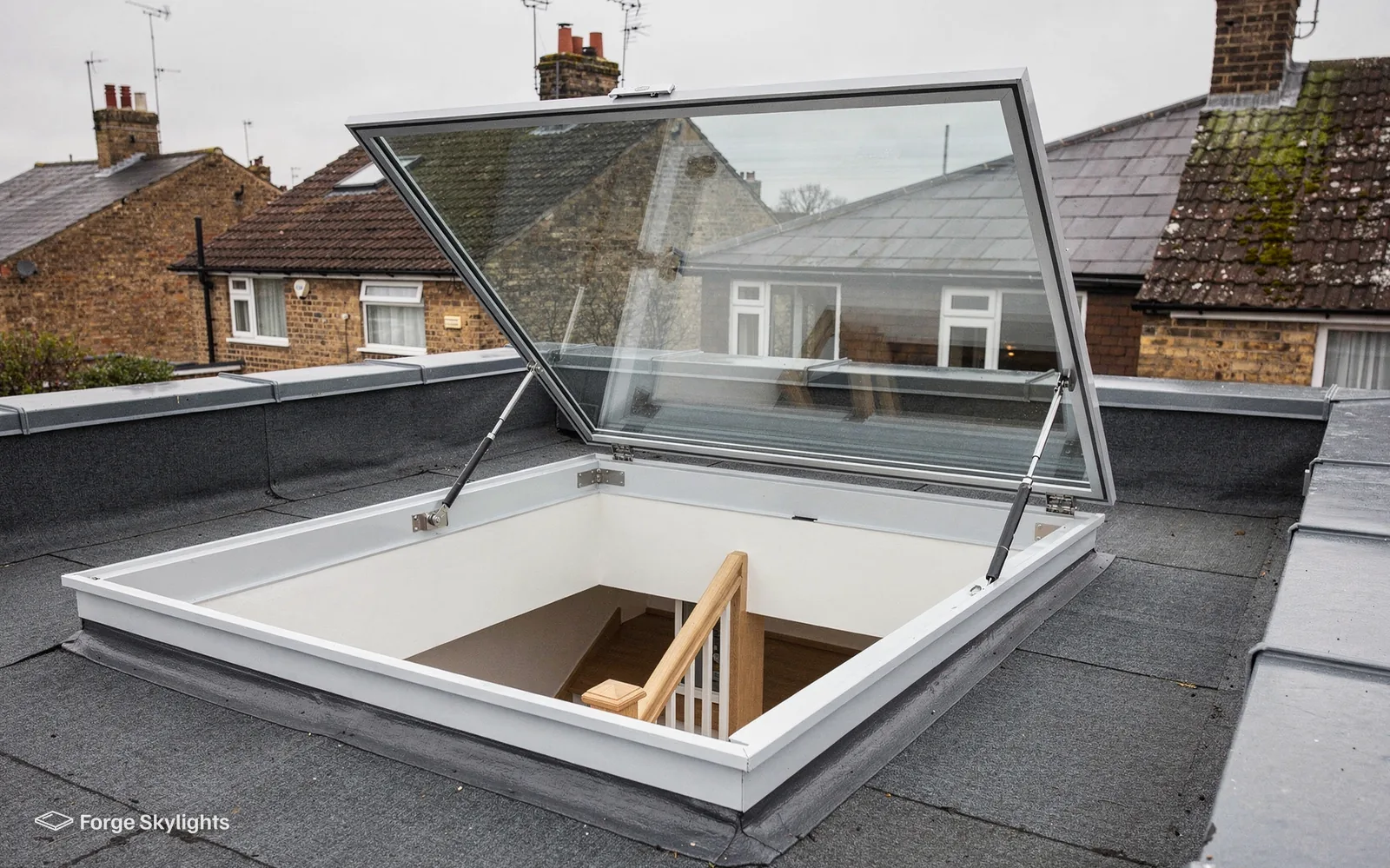
A ventilation rooflight opens a hand's width to a forearm's width, enough to move air. An access rooflight opens fully, with a sash that lifts or slides clear so a person can climb out onto a flat roof to reach gutters, a plant room or a roof terrace edge. They look similar from below and behave very differently in use.
Our answer on which rooflight gives access to a flat roof compares hinged hatches and sliding units on opening size and the stair or ladder below. An access hatch needs a way to reach it, and the opening needs to be large enough for the person and the tools. We also look at what is beyond the hatch on the roof, because a person stepping out needs a safe place to stand and a way to avoid the edge.
A flat roof that people will walk on regularly is a different brief, covered by our page on walk-on rooflights.
Sizing for the room and the sash
An opening rooflight is sized from the room first, then from the opener. A very wide sash needs a longer or twin actuator, and there are limits on how heavy a glass sash a motor will lift. We take the room dimensions, the kerb size and the weight of the glazed sash into account when we compare units, and the maker's stated range goes on the quote.
Ceiling height matters too. The higher the ceiling, the more you gain from a motor and the less you can reach by hand.
Where several rooflights share a long roof, the question becomes whether they open together. Two or three units on one control can ventilate a large kitchen extension evenly, while a single large unit is simpler to wire and has fewer moving parts. Both arrangements go on the quote when the room could take either, with the controls priced for each.
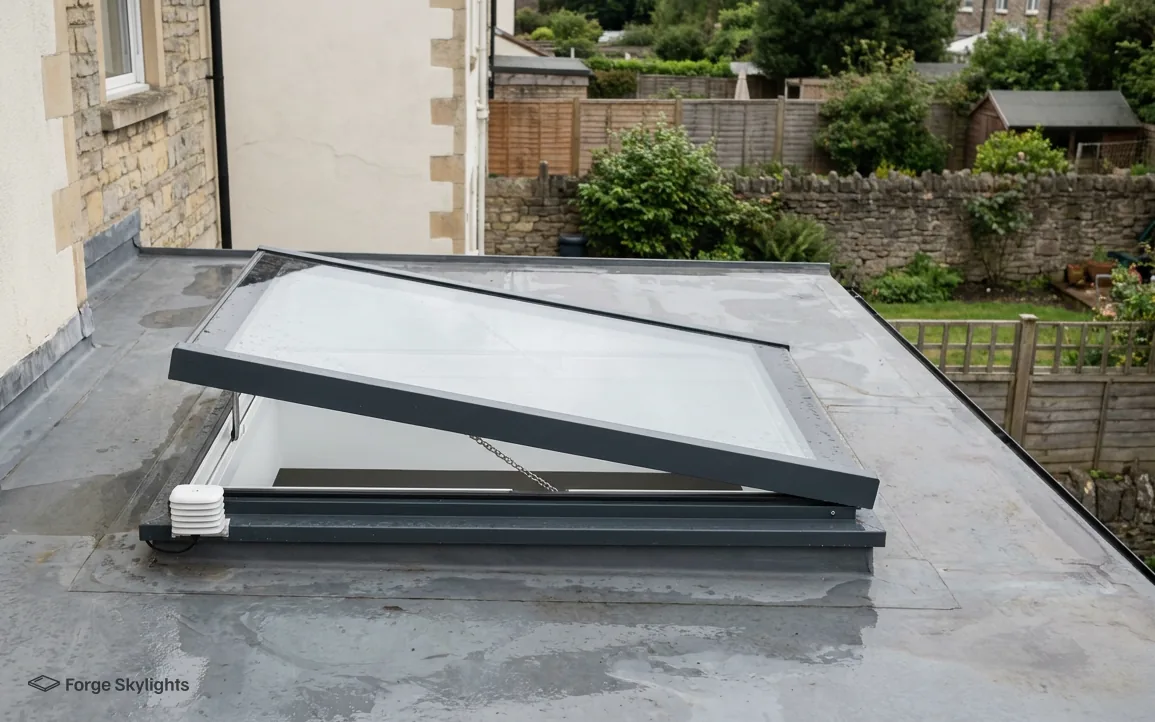
A hatch that opens wide enough to climb through is a different unit from a vent that opens a few inches.
Planning, cost, lead times and fitting
- Planning
- Cost
- Fitting
Permission and Building Regulations
Many rooflights on a house are covered by permitted development, with the applicable conditions listed in our rooflight planning guide. An opening unit on a listed building, a roof under a planning condition or a property caught by an Article 4 direction may be treated differently, so we look into the address first, and the final word belongs to the council.
Changing the whole rooflight, glass and frame, is work on a controlled fitting, so it has to be notified, whereas a new opening cut into a roof is building work that falls under the Building Regulations. Notifying Building Control falls to us whenever the job requires it.
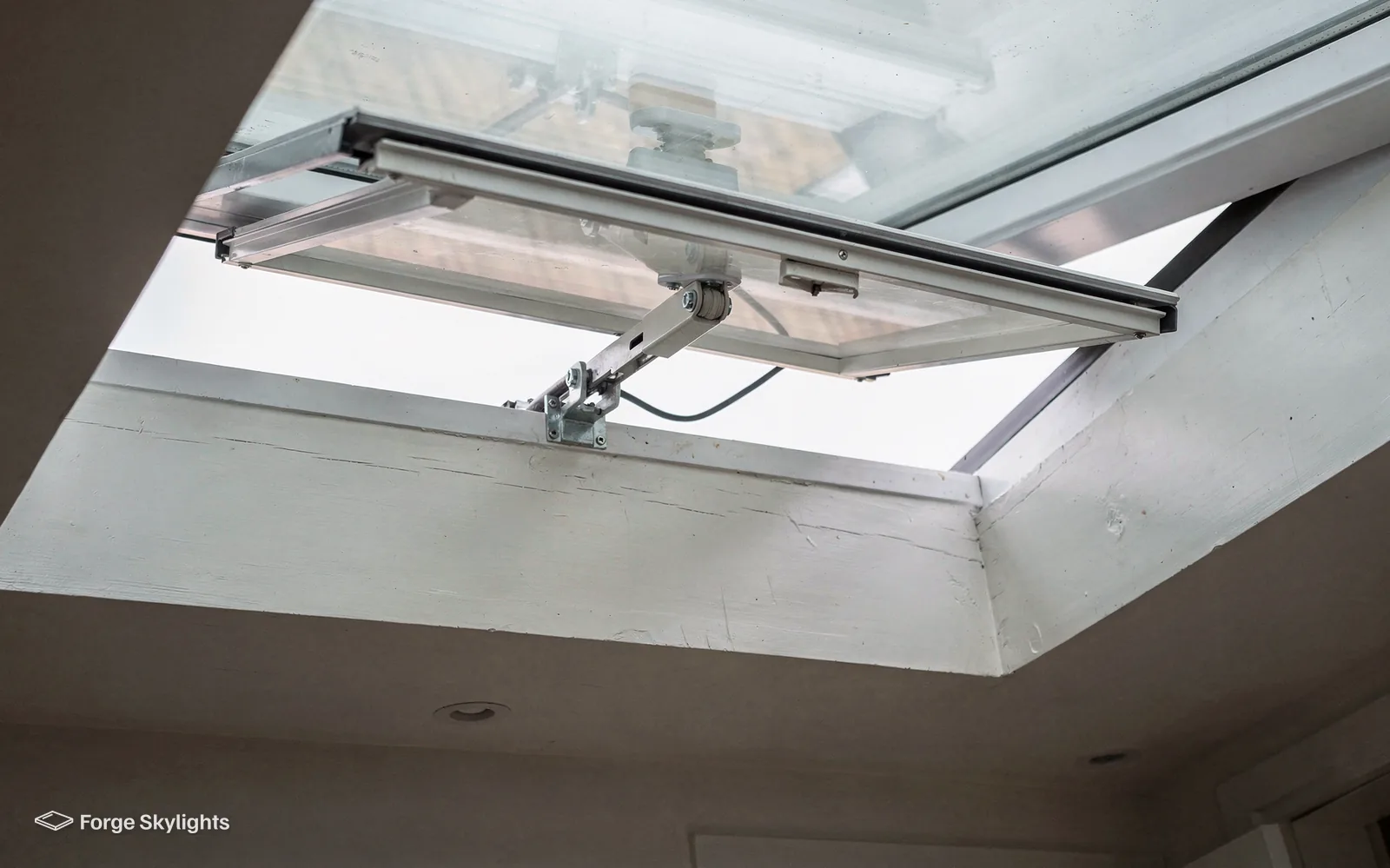
What drives the price
The price of an electric rooflight comes from the unit, the motor and controls, any rain sensor, the wiring and the roof work around it. Our answer on what an electric rooflight costs explains each part in turn.
Manual units usually cost less than electric ones, and a solar unit usually costs more to buy than a mains one. The wiring is where a finished ceiling can add to a mains quote.
| Item | Lower | Higher |
|---|---|---|
| Opening | Manual | Electric |
| Power | Mains in an open ceiling | Solar, or mains in a finished room |
| Rain sensor | Not fitted | Fitted |
| Glass | Double glazed | Triple, or solar control |
| Lead time | Stock sizes | Made to measure |
Fitting day, finish inside and replacing an old unit
On a new roof, the kerb is built with the deck and the cable is already waiting. On an existing roof, the covering is cut back, the opening trimmed and the new covering joined to the old around the kerb. The actuator is usually set at the factory, and we test the full travel before we leave.
Inside, a plastered box or a lining finishes the opening between the ceiling and the glass. A deeper box spreads light and hides the motor, while a shallow one keeps the room feeling taller. The quote shows the finish so the decorator knows what to expect.
An old rooflight that has failed, or a misted sealed unit, can sometimes be replaced with an opening version in the same kerb. How we separate a glass unit swap from a whole new rooflight is covered on our misted and failed rooflight replacement page. Our page on VELUX windows covers the pitched-roof equivalents.
Our fitting carries a 10-year workmanship guarantee of its own, while the unit and its motor keep the maker's warranty alongside it. What the guarantee covers is written up on our guarantee page. Each option's lead time is the typical range the maker gives, shown on your quote, and made-to-measure units often take longer than stock sizes.
Looking after an opening rooflight
Rinse the glass and wipe the rain sensor, then sweep any leaves off the roof around the kerb. Run the opener through its full travel now and then, so you notice early if it slows. A hinge or an actuator that sounds different is worth mentioning to us while the guarantee is running.
Check the seals when you clean the glass: a seal that has flattened or split is easy to spot and quick to put right.
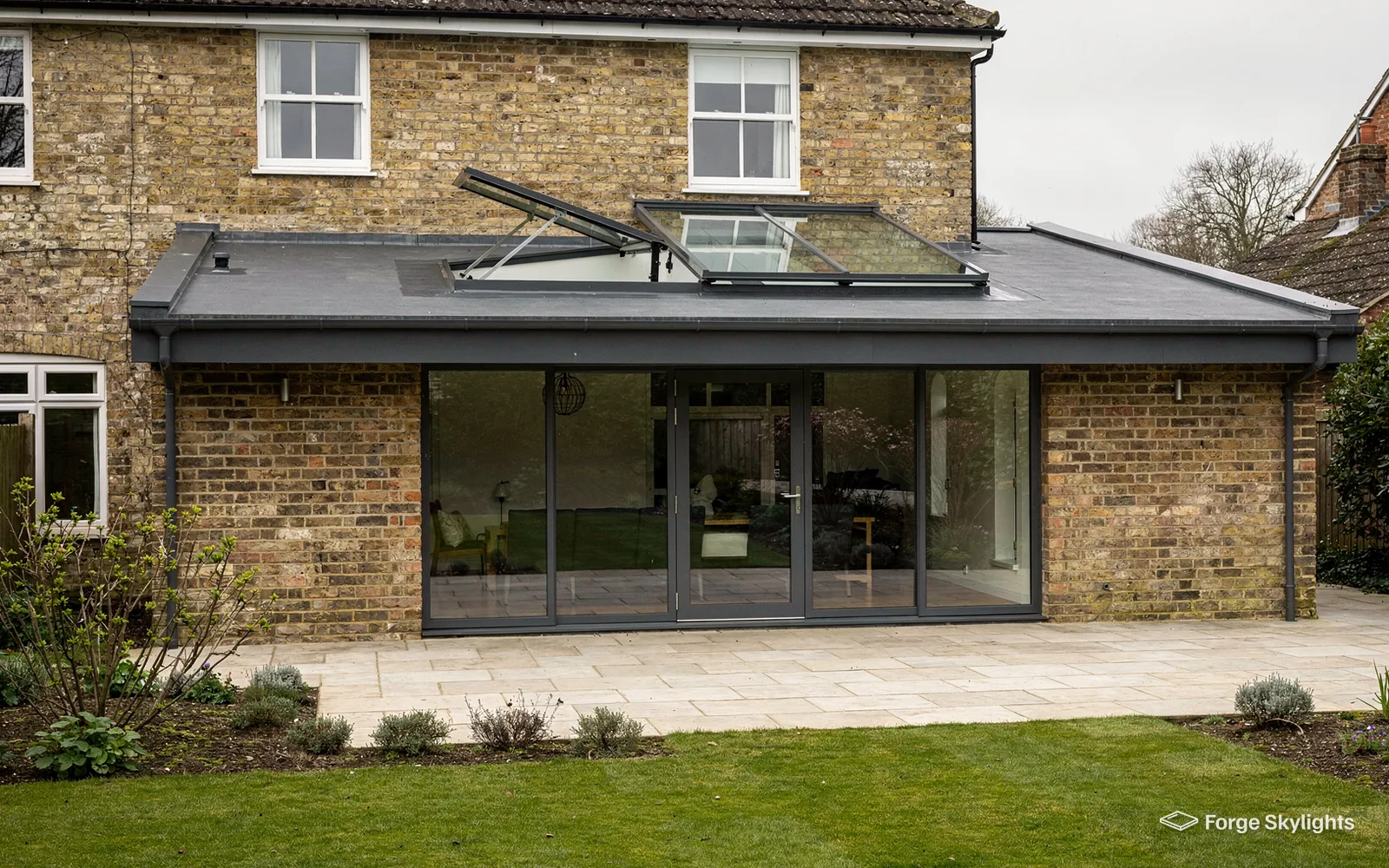
Ready to see manual, mains and solar units priced on one sheet? Book a free survey and we will measure the roof, the ceiling and the cable route.
Book a free surveyOur simple process
- 1
Free survey
We measure the opening, the ceiling height and the cable route.
- 2
Options side by side
Manual, mains and solar versions go onto one sheet for you to compare.
- 3
You choose
You pick the controls and the way it opens.
- 4
Fitted, signed off, guaranteed
Fitted, wired, signed off and guaranteed.
Electric and opening rooflight questions
Do I need an electrician to fit an electric rooflight?
The final connection to your supply is made by a qualified electrician. We agree at the survey who arranges it and mark the cable route, so the work is planned before the ceiling is closed. A solar unit has no cable to connect.
Can I add a motor to a manual rooflight?
Sometimes. It depends on the maker and the model, because the actuator and the frame have to match. Where the unit cannot take a motor, we quote a replacement sash or a new rooflight and set it against the cost of keeping the manual one.
Will an opening rooflight let in noise or insects?
An open vent lets in the sound of the garden and the street, as an open window does. Some makers offer insect screens for their opening units, and we note whether one is available on the quote.
Do I need planning permission for an opening rooflight?
Permitted development under Class C covers many opening rooflights, and our rooflight planning guide lists what has to be met. A listed building, a planning condition on the property or an Article 4 direction may alter that, so the address gets checked on our side and the decision stays with the council.
How long does an electric rooflight take to arrive?
Arrival depends on who makes it, how large it is and which glass you choose. Off-the-shelf sizes tend to reach you sooner than units made to measure. At the time of quoting we put the maker's usual range for each option in writing.
What if the motor fails after a few years?
The maker's warranty covers the motor and the unit for the period it states, and our 10-year workmanship guarantee covers our fitting. We explain both in writing at handover, and on many units the motor can be replaced without a new rooflight.
Can an opening rooflight be fitted in a bathroom?
Yes, with controls placed away from the wet area. A bathroom is a good place for one, because steam rises to the ceiling and leaves through the vent. We position a switch or remote where wet hands will not reach it.
Will you quote units from more than one maker?
Our quotes draw on different makers, and on a roof that allows it we price units from two or more of them and compare each on identical measures. If you already have a particular rooflight in mind, we price that one first and put the alternatives beside it.
Guides and answers
 Guide · 11 min readWiring an electric rooflight: power, controls and sensorsAn electric opening rooflight needs a power supply, a way to control it and, usually, a rain sensor, and all three are…
 Guide · 10 min readManual or electric opening rooflight: the two comparedA manual opening rooflight costs less and has no motor to fail; an electric one reaches the high places, shuts itself against…
 Answer · 4 min readHow much does an electric rooflight cost?An electric rooflight price is built from six parts: the rooflight unit, the motor, the controls and sensors, the wiring, the roof…
 Answer · 4 min readDo electric rooflights close by themselves when it rains?An electric rooflight closes by itself in rain only if it has a rain sensor, and the sensor is a separate part…
 Answer · 4 min readWhat happens to an electric rooflight in a power cut?A mains electric rooflight stops moving when the power fails and stays in whatever position it had reached, open or shut.
 Answer · 4 min readWhich rooflight gives access to a flat roof?Two kinds of rooflight give access to a flat roof: a hinged access rooflight, which lifts at one edge and suits a…
Book your free survey
It starts with a free survey and plain advice. No pressure, just clear options for your home.
Fill in the form and we will be in touch to arrange a convenient time.