
Last updated 13 October 2026
In brief
Why rooflight prices vary so much
Two quotes for a rooflight can look far apart and still both be fair, because they are often pricing different jobs. One may cover a stock-size fixed unit dropped into an existing kerb on a flat roof that is easy to reach. Another may cover a made-to-measure triple-glazed opening unit, a new kerb, a fresh roof covering around it, scaffold at the front of the house and a fully plastered reveal inside. The word on both quotes is "rooflight", and the work behind each one is very different.
We publish no price list, because a fixed figure on a web page would be wrong for nearly every roof it met. What we can do is explain each thing that moves the price, so a quote from us, or from anyone else, makes sense when it lands. After a free survey you get the fitted price for each suitable option in writing, with the parts that drive it set out underneath.
Each option on our quote carries its own fitted price, with the roof work and the inside finish included.
What you pay for
The parts of a fitted price
A fitted rooflight price is built from a handful of parts. Some belong to the unit and change with the option you choose; others belong to the roof and the house and stay much the same whichever unit you pick. Seeing the two groups apart is the quickest way to understand where a saving is possible and where it is not.
| Part of the price | What it covers | Changes with the option you pick? |
|---|---|---|
| The unit | The rooflight, lantern or roof window itself, with its glass, frame and opening gear | Yes, and usually the biggest single swing between options |
| Kerb or upstand | The raised frame a flat rooflight or lantern sits on, built on site or supplied by the maker | Sometimes, as some units come with their own upstand |
| Roof work | Cutting or altering the opening, trimming joists or rafters, and making good the covering and flashings around the unit | Rarely, as it follows the size and the roof |
| Access | Ladders, a tower, roof edge protection or scaffold so the work can be done safely | Rarely, as it follows the house and the garden |
| Inside finish | Lining, boarding and plaster around the opening, ready for your decorator | A little, if a bigger unit needs a bigger reveal |
| Paperwork | The Building Control notification where the work is notifiable | No, it follows the type of work |
The unit
Size and product type
Size is the plainest driver. A larger pane needs thicker glass and a stiffer frame, weighs more and takes more work to lift into place, so the unit price rises with it, and a wider opening in the roof can mean more structural work below. Standard sizes cost less than made-to-measure ones because the maker builds them in quantity, which is why we often show a stock size beside a bespoke one when both would fit.
The type of product matters as much as its size. A small fixed flat rooflight is usually the most modest job on a flat roof; a roof lantern of the same footprint uses more glass and more frame, and usually costs more. On a pitched roof, a standard roof window into tiles is a familiar, well-understood job, while a conservation rooflight with a slim profile and a glazing bar tends to sit higher. Walk-on glass is built to carry people and costs more again, while a sun tunnel is a small unit and often the least expensive way to bring daylight into a room with no window.
Three flat-roof products for the same kitchen extension
Fixed flat rooflight
- Unit cost
- Lowest
- Glass area
- One flat pane
- Roof work
- Kerb and covering
- Lead time
- Often shortest in stock sizes
See our flat rooflight installation page.
Opening flat rooflight
- Unit cost
- Middle
- Glass area
- One flat pane
- Roof work
- Kerb, covering and a power supply if electric
- Lead time
- Maker's typical range, on the quote
Compared on our opening rooflight page.
Roof lantern
- Unit cost
- Highest of the three
- Glass area
- Several pitched panes
- Roof work
- Kerb and covering, often a stronger opening
- Lead time
- Made-to-measure frames add time
Set out on our roof lantern installation page.
Glass and frame
The specification you choose
Glass is where two units of the same size part company on price. A third pane holds more warmth in the room than two and usually costs more; it also adds weight, which can matter on a large lantern. Solar control coatings cut the heat that builds up under south-facing glass, self-cleaning coatings help rain wash the outer pane, and a laminated inner pane holds together if the glass is ever broken. Each of these adds to the unit price, and each is worth having in some rooms and not in others.
| Glass choice | What it adds | Effect on cost |
|---|---|---|
| Double glazing | Meets the Part L limit for the product type on our quotes | The starting point for most options |
| Triple glazing | A lower stated U-value than the double-glazed version | Usually costs more, and adds weight |
| Solar control coating | Reduces heat build-up under glass that takes the afternoon sun | Adds to the unit price; see our solar control glass answer |
| Self-cleaning coating | Helps rain clear dirt from the outer pane, best on a sloping unit | A modest extra; see our self-cleaning glass answer |
| Laminated inner pane | Holds the glass together if it breaks | A modest extra, standard on some units |
The frame follows the same pattern. A uPVC lantern frame usually costs less than an aluminium one, while aluminium gives slimmer sightlines and a wider choice of colours. Pine and white-painted timber roof windows sit at different points in a maker's range, and a polyurethane-coated frame for a bathroom usually costs a little more than plain pine. The two lantern frames are set against each other in our aluminium or uPVC guide.
Opening
Fixed, manual or electric
A fixed rooflight lets in the same light as an opening one of the same size for less money; what you give up is fresh air through the roof. A manual opener adds hinges, a stay and a seal, and a rod or handle to reach it. An electric unit adds a motor, a control and usually a rain sensor that closes it when the weather turns, plus a power supply that an electrician has to bring to the opening. Each step up usually costs more than the one before.
The same size of rooflight, three ways to open it
Fixed
- Unit cost
- Lowest
- Fresh air
- None through the roof
- Extra work
- None beyond the fitting
Manual opening
- Unit cost
- Middle
- Fresh air
- Yes, when you can reach it
- Extra work
- A pole or handle within reach
Electric opening
- Unit cost
- Highest
- Fresh air
- Yes, from a switch or remote
- Extra work
- Wiring to the unit
The electric rooflight cost answer covers the motor and wiring in more depth, and the guide to manual and electric opening rooflights helps decide whether the extra is worth it for your room.
The roof
New opening or replacement, flat or pitched
A replacement into an existing opening is usually simpler than a new one. Where the old unit comes out and a new one of the same size goes in, the structure is already there and the roof work is limited to the flashings and covering around the frame. A new opening means cutting the covering, trimming the joists or rafters to carry the load around the hole, and weathering the new unit into the roof. If you want a bigger rooflight than the old one, the job moves part of the way towards a new opening.
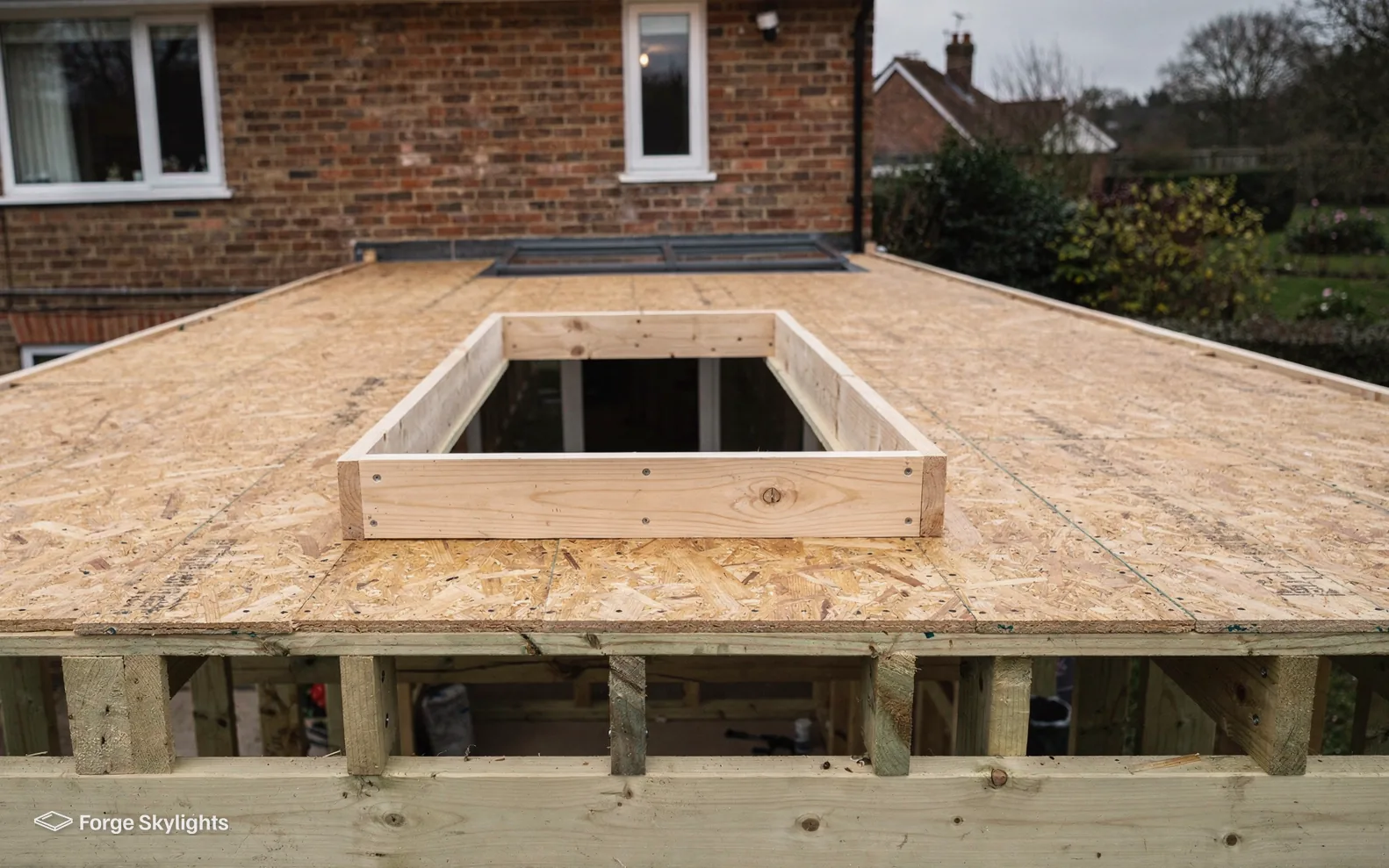
On a flat roof the kerb or upstand is a real part of the cost. Many flat rooflights need a raised kerb so the glass sheds water and sits clear of the covering; that kerb can be built from timber on site or bought from the maker as an insulated upstand, and the two cost different amounts. Our guide to flat rooflight upstands and kerbs compares them. The covering matters too: EPDM, GRP and felt each finish around a kerb in their own way, explained in our answer on rooflights for EPDM, GRP and felt roofs.
If the flat roof is tired and due for renewal soon, it can make more sense to put the rooflight in as part of a new covering than to cut into a tired one. We say so on the quote when we see it, and our answer on adding a lantern to an existing flat roof explains where that line falls.
On a pitched roof the covering decides the flashing kit. Roof windows come with flashings made for profiled tiles, flat tiles or slate, and a recessed fit sits lower in the roof and uses a different kit again. Our answer on matching a flashing kit to your roof runs through the choices. Slate and clay tile take more care to strip and relay around the frame than concrete tiles, and that time shows up in the price.
Access
How we reach the roof
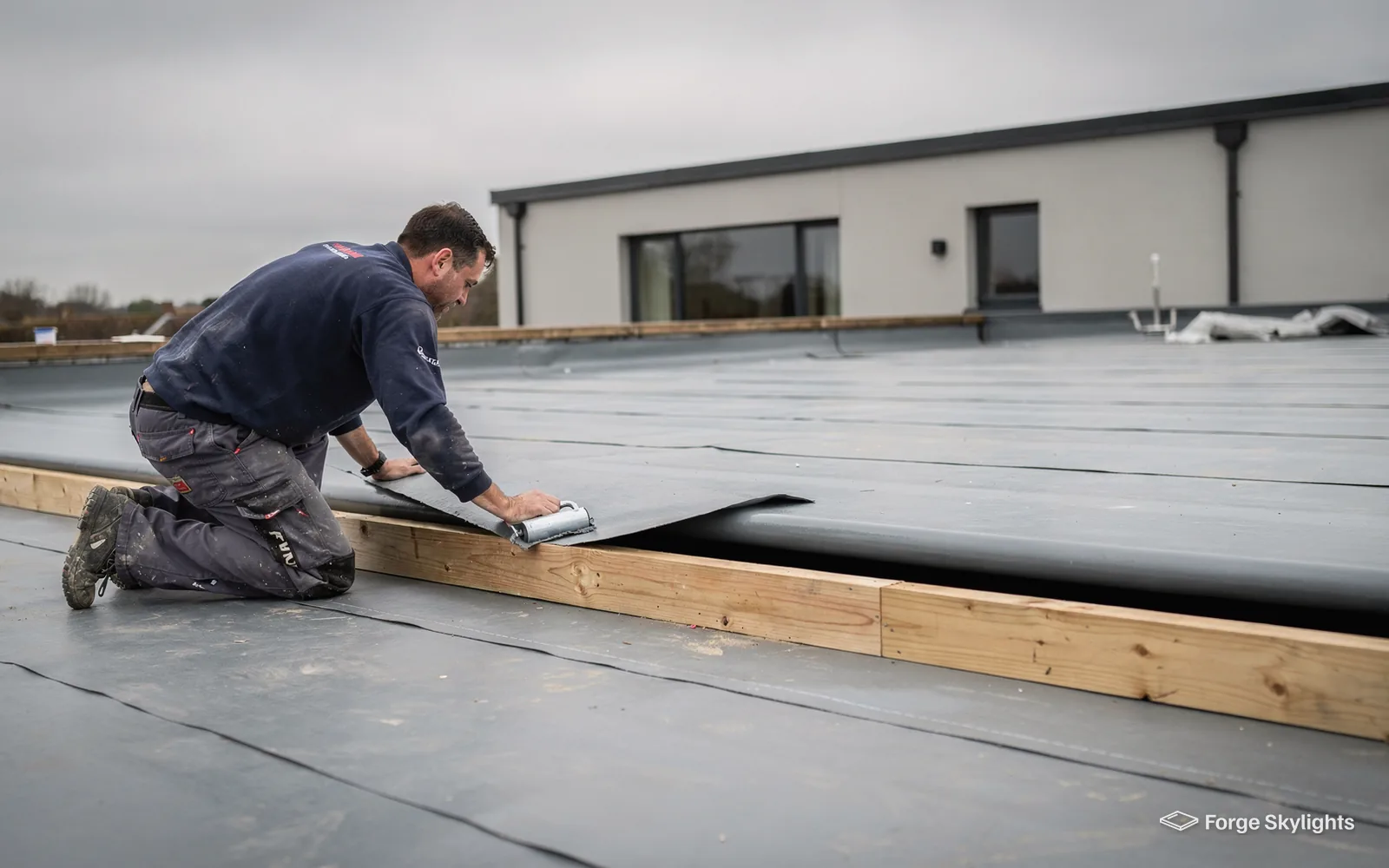
Access is the cost homeowners least expect. A single-storey extension at the back of a house with a clear garden can often be worked from ladders and a small tower with edge protection. A roof window on the front slope of a two-storey house, a lantern on an extension that can only be reached through the house, or a rooflight above a conservatory all need more, and sometimes that means scaffold. Scaffold is priced by the scaffolder for the height, the length of run and how long it stands, so it can move a quote noticeably.
Some roof windows can be fitted from inside the loft, which may reduce the outside access needed. It depends on the size, the roof covering and how safely the flashing can be dressed from the opening, and the limits are in our answer on fitting from inside the loft. Where two access methods would both be safe we price the simpler one and tell you why.
- Height of the roof and which slope
- A clear route to the back of the house
- Room for a tower or scaffold
Inside
Making good around the opening
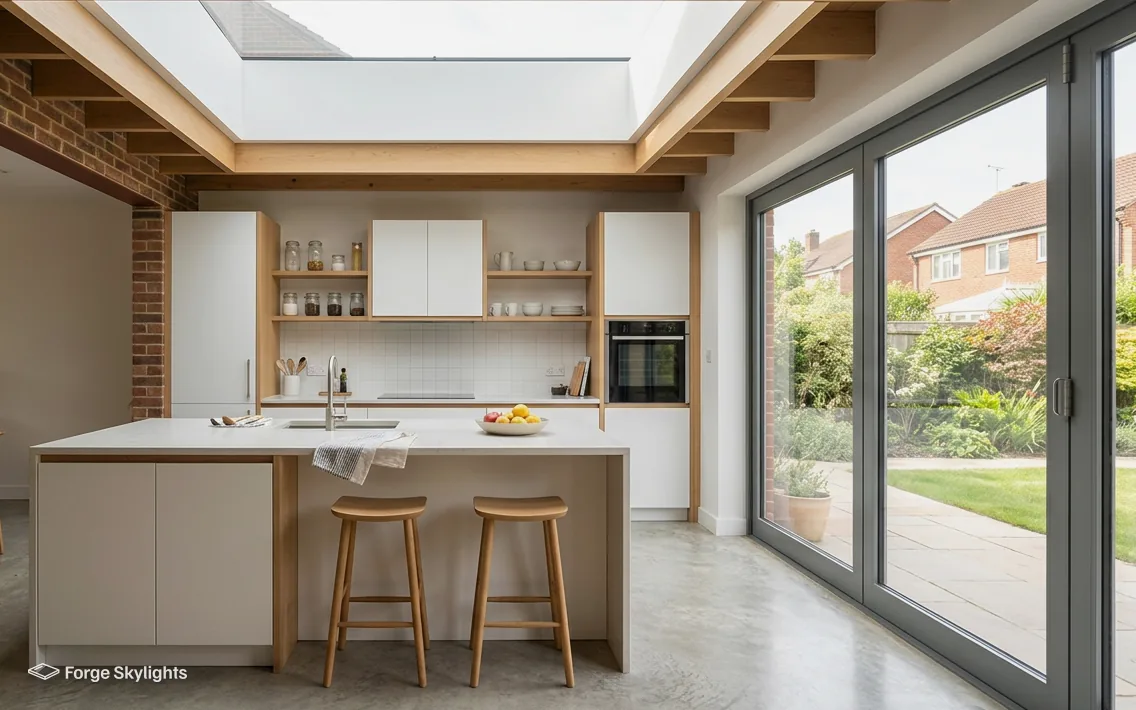
Once the unit is in, the opening inside needs finishing. On a new rooflight that means lining the shaft or reveal, insulating behind it, boarding and plastering so the room is ready for paint. On a like-for-like replacement the existing reveal can often stay, with only the edges made good where the old frame came away. A bigger unit in an old opening, or a lantern over a newly formed ceiling, needs more of this work, and the quote shows it.
Blinds are a smaller extra but easier to plan at the start. Roof window blinds made for a particular model fit neatly in the frame, and blackout or heat-reducing fabrics are priced differently. Our answer on fitting blinds with a VELUX window compares the main types.
Regulations and planning
Building Control and permission
Some rooflight work is notifiable under the Building Regulations. Replacing a whole rooflight, frame and glass together, is notifiable as a controlled fitting, while replacing only the sealed glass unit is not. A new opening in a roof is building work. Where the job is notifiable we handle the Building Control notification, and any fee for it is shown on the quote so it is never a surprise later. Our answer on rooflights and Building Regulations explains the rules in full.
Planning often adds nothing to the bill, because many rooflights fall under permitted development, subject to the conditions in our rooflight planning guide. A listed building, an Article 4 direction or a planning condition on the house changes that, and a conservation area can change which products suit the roof. We check the position for your address and tell you what we find; the council decides. Where an application or listed building consent is needed, the quote says so, and our answer on listed building rooflight consent covers that route.
Replacement
Glass only, like for like, or an upgrade
If your rooflight has misted between the panes, the most economical fix that lasts depends on what has failed. A failed sealed unit in a sound frame can sometimes be swapped on its own. A tired frame, a perished seal or a unit that no longer meets current standards usually points to a whole new rooflight, and that opens the door to a better specification.
| Route | What happens | Relative cost | Notifiable |
|---|---|---|---|
| New sealed unit only | The old glass comes out of the existing frame and a new sealed unit goes in | Usually the lowest | No |
| Like-for-like unit | The whole rooflight is replaced with a current unit of the same size | Middle | Yes, as a controlled fitting |
| Upgraded unit | A better-glazed, opening or larger unit goes in, with the roof work that needs | Usually the highest | Yes, and a larger opening is building work |
Our guide to new glass or a new unit for a misted rooflight helps you tell which one your roof needs, and our answer on what skylight replacement costs goes through the drivers for each route.
Our quote
How the written quote lays out the cost
Our quote puts the suitable options in columns and the five measures in rows: glass, frame, opening, lead time and price. Below the options sit the parts of the job that stay the same whichever you choose, such as access, roof work and the inside finish, so you can see that a change of unit moves one figure and leaves the rest alone.
| Measure | Option A | Option B | Option C |
|---|---|---|---|
| Product | Fixed flat rooflight, stock size | Electric opening flat rooflight | Aluminium roof lantern, made to measure |
| Glass | Double glazed | Triple glazed | Double glazed with solar control |
| Frame | Aluminium, grey outside and white inside | Aluminium, grey outside and white inside | Slim aluminium, colour of your choice |
| Opening | Fixed | Electric with a rain sensor | Fixed, with an opening vent as an extra |
| Lead time | The maker's typical range, stated | The maker's typical range, stated | The maker's typical range, stated |
| Price | Fitted price for option A | Fitted price for option B | Fitted price for option C |
Each option shows the maker's name as a fact about the product, and a roof that takes several makes gets units from at least two of them. Our recommendation sits at the foot with a short reason, and the decision stays with you. See how we compare your options side by side for the full format.
Spending well
Where a saving makes sense
- Pick a standard size where it fits the room. A stock unit usually costs less and often arrives sooner than a made-to-measure one.
- Go fixed where you have other ventilation. A fixed unit gives the same light for less, and a window or door nearby may already give you the air.
- Fit with the roof. If the flat roof is due a new covering, putting the rooflight in at the same time shares the access and the roof work.
- Group the work. Two roof windows on the same slope share the scaffold or tower, so they cost less together than on separate visits.
- Spend where you live. Triple glazing or solar control earns its place over a kitchen table that gets the afternoon sun, and less so over a hallway.
Some extras are worth paying for even on a tight budget. A rain sensor on an electric unit in a room you often leave open, a laminated inner pane over a space where people sit, and a properly insulated kerb on a flat roof all earn their cost over the life of the rooflight. We point them out on the quote and leave the call with you.
Cost by product
Cost answers for each type of rooflight
Each product has its own answer page that goes further into the drivers above. None of them carries a price list; each explains what moves the cost for that product and how we set the options out.
- How much a roof lantern costs, on new and existing flat roofs.
- How much a flat roof rooflight costs, from single panes to paired units.
- What a roof window costs to fit, for new openings and swaps.
- What VELUX installation costs, set beside comparable units from other makers.
- What an electric rooflight costs, with the motor and wiring.
- What a walk-on rooflight costs, for terraces and light wells.
- What a conservation rooflight costs on older roofs.
- What a sun tunnel costs for dark hallways and bathrooms.
- What skylight replacement costs, like for like or upgraded.
When you are ready for figures that fit your own roof, book a free survey and we will come back with the options side by side.
Questions
Why is there no price list on the site?
A rooflight price depends on the size, the glass, the roof and the access, so a list would mislead more people than it helped. Your written quote gives a fitted price for each option after we have seen the roof.
Is the survey really free?
The survey and the written quote cost you nothing, and there is no obligation to go ahead with any of the options on it.
Does a bigger rooflight always cost more?
The unit price climbs with size, and a wider opening can add roof work. Sometimes a single larger unit costs less overall than two small ones, because it needs one kerb and one set of flashings, and we show both when either would suit.
Is the Building Control fee included?
Where the work is notifiable, the notification and any fee for it are shown on the quote, so the price you agree covers it.
Why might your quote differ from another firm's?
Quotes often price different units, different access or a different finish inside. Lay them next to each other on glass, frame, opening, lead time and price, and the gap usually explains itself.
Can I add an opening vent or blinds later?
Some units take a motor or a blind after fitting and some are easier to order with them from the start. We note on the quote which extras can be added later for each option, so you can decide now or wait.