
The question in plain terms
The difference is where the sash turns. A top-hung roof window is hinged along its top edge and you push the bottom edge outwards, so the glass swings up and away like an awning. A centre-pivot roof window turns on a horizontal bar across the middle of the sash: you lift a handle on the top rail, the top half swings into the room and the bottom half swings out over the roof. Everything else in this guide follows from that single difference in how the glass travels.
Neither is better in the abstract. A centre-pivot is the familiar skylight in many loft rooms, and it is usually the lower-cost choice and the easier one to clean. A top-hung window gives more room to move beneath the open sash and a clearer way out onto the roof or into the fresh air, which is why it appears over stairs, in bathrooms and in rooms where the window sits higher up the slope. The right one for you depends on where the window will sit and what is underneath it.
On a rooflight survey we put both on the same quote wherever the roof suits them, from more than one maker, and we show you where each sash would travel when open. The measures below are the ones we go through at the survey, in the order people usually ask about them. If you want to see how the makers compare on other points, our page on roof window makes compared sets them out, and the hub page on roof window installation covers the whole range.
How each one moves
Movement is easiest to judge by picturing someone standing at the window with the sash open. With a centre-pivot, the top edge of the glass comes towards you at about head height, while the bottom edge goes out and up over the roof tiles. With a top-hung, the whole sash rises away from you, with the bottom edge furthest out, and the opening under it is open from the sill up to the lifted glass.
How the sash travels
Top-hung
- Hinge
- Along the top edge
- Handle
- On the bottom rail
- Open sash
- Lifts out and away from you
- Turns fully over
- On models with a cleaning position
The glass finishes outside the room, with clear space beneath it.
Centre-pivot
- Hinge
- On a bar across the middle
- Handle
- On the top rail
- Open sash
- Top half swings into the room
- Turns fully over
- Yes, for cleaning
The top rail comes inward, so the space just below it needs to be clear.
Some makers list windows that combine the two movements, and where one suits the roof and the room we add it to the quote. Whether a particular size and pitch is offered in a combined version is stated in the maker's data, and we confirm it before quoting.
The handle position matters too. A centre-pivot is opened from the top, so it is normally placed where you can reach the handle comfortably, with the bottom of the glass at about sill or work-surface height. A top-hung is opened from the bottom rail, so it works well when the window sits higher up the slope, and when it sits above a stair or a bed where you would rather not reach up. Where the reach is awkward, an electric or remote-controlled version of either type removes the problem, and our page on electric opening rooflights explains what that adds.
Headroom and furniture below
Headroom decides more roof window choices than anything else, because a window that swings into the room can meet your head. With a centre-pivot, the top edge of the sash comes inward as you open it, so the area under the top rail needs to stay clear. In a tall loft room that is easy. In a low slope, or over a bed placed close to the eaves, the top rail can end up where you stand or sit up.
A top-hung sash lifts away from the room, so nothing comes inward at head height. That is the main reason it is chosen for rooms with a low slope, for windows over a stair, and for a bed placed beneath the glass. If you have a desk or a worktop under the window, a top-hung sash also lifts clear of it and leaves a wide opening to reach through.
Blinds and curtains change the picture. Blinds sit inside the frame and a centre-pivot sash swings in to meet them, so a blind that is wide open must be wound back before the sash turns. We check the blind choice together with the opening type, and every blind on the quote is listed with the window it suits.
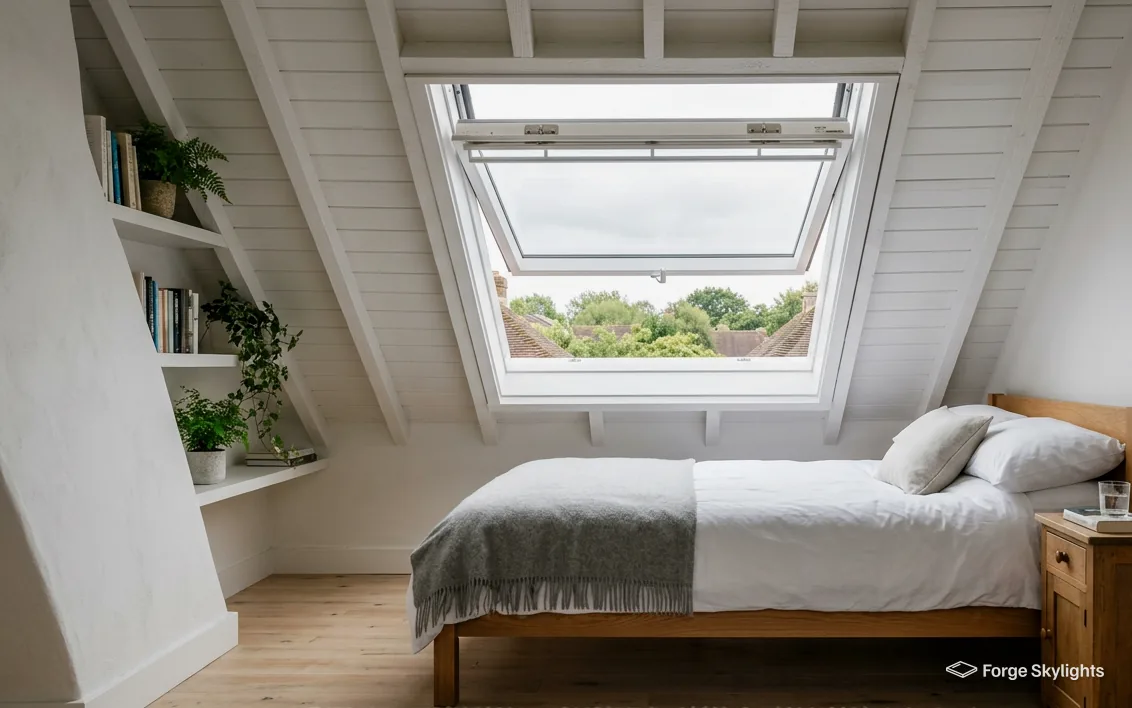
Furniture plays a part before the window is chosen. If a wardrobe, a bookcase or a bed head sits below, we mark its position on the plan and draw the sash path over it. That small drawing usually settles the choice in a few minutes, and it avoids the case where a handsome window cannot open fully because of a chest of drawers.
The view out and the light
Seen from inside with the sash closed, the two windows look similar: the same glass, the same frame depth and the same flashing outside. The difference shows when the sash is open. A centre-pivot, opened part way, leaves two gaps, one at the top where air enters and one at the bottom where it leaves, and your view is across the open sash. A top-hung opens as one wide gap beneath the lifted glass, and looking out means looking beneath the sash, which gives an unbroken view of the garden or the street.
Both bring the same daylight when closed, because the glass area is set by the frame size and not by the opening type. Where the two part company is how they deal with direct sun. Neither opening type changes how much sun the glass lets in, so we keep blinds in mind for south and west facing slopes.
Ventilation is the other point where they differ. A centre-pivot opens at the top and the bottom together, so air can pass through in a loop, warm air leaving at the upper gap and cooler air coming in lower. A top-hung gives a single opening, which still ventilates well but does less to pull stale air out. Both usually have a trickle vent or a latch position that keeps the window open a crack for background ventilation, a feature that suits bedrooms and bathrooms where the window will not be fully opened often.
A centre-pivot's top rail swings into the room, so the space below it has to stay clear.
Cleaning, access and the roof
Cleaning is where the centre-pivot earns its place. Turn the sash through half a circle, a position it holds on a catch, and the outside pane faces you, so you can wipe both sides from inside the room. For a window over a stair or a landing that you cannot reach from outside, this is a real gain, and it is the reason centre-pivots are common on roofs where nobody wants to climb a ladder.
A top-hung sash lifts away from you, so cleaning the outside means reaching out from the room or going up onto the roof. On a low roof that you can reach safely, that is easy enough. On a steep or high roof it may call for a cleaner with the right access, and any model with a cleaning position is marked as such on the quote.
Access to the roof also affects which type you can choose. A top-hung window that opens wide can serve as a way onto a flat or low section of roof, for maintenance of a neighbouring surface or a view out. Roof access models are a separate product from an ordinary roof window, and the maker's data says which sizes and pitches they come in. A centre-pivot sash swings through the room, which makes it a poor way out. If you want a roof access window, our page on roof access rooflights covers the options.
For the roof itself, both types are flashed in the same way. The sash type does not change the flashing, the batten spacing or the roof covering, so the roofing side of the job is the same. What changes is the frame depth for the hinge mechanism, and the maker's data sheet states this for each model.
Escape windows and loft conversions
If the window is meant to serve as the way out from a bedroom or a habitable room in a loft, the opening type matters more than anything else on this page. An escape window must open wide enough, and be placed low enough, for a person to climb out, and the rules in Approved Document B set the size and position of that opening. A top-hung window usually opens more cleanly and wider at the sill, so it is the common choice for an escape window.
There is a limit that no choice of window can change. Windows count as escape routes only on storeys within 4.5m of ground, so a two-storey house with a loft conversion has to rely on a protected stair, whichever opening type you choose. Where the property is a chalet bungalow or a plain bungalow, a roof window can serve the rooms in the roof inside that height.
Check the opening size
Makers state a clear opening size for each model in each position. We check the figure on the data sheet for the window on your quote rather than relying on the type alone. Our page on roof windows as a fire escape explains what to look for.
For a loft conversion more broadly, the window type also affects the stair head, the position of the bed and how the room meets the eaves. Our guide to roof windows for a loft conversion shows how the choice fits the whole room, and the building control side is explained on our page about rooflight Building Regulations.
Price, pitch and where each one fits
On cost, a centre-pivot is normally the lowest-cost option in a given size, because it is the common, high-volume design. A top-hung usually costs more, and a combination window or an electric version costs more again. The size, the glass specification, the flashing kit and the blinds all change the final figure, so we price each option in full on the quote and show them next to one another.
Pitch is the other point. Each model has a range of roof pitches stated by the maker, with a lowest and a highest slope. Centre-pivot ranges usually reach steeper slopes than top-hung ones, so a very steep roof can rule a top-hung sash out, and we check both ends of the range against your roof. If your roof is shallow, our page on roof windows on a low pitch explains what changes.
| Item | Top-hung | Centre-pivot |
|---|---|---|
| Headroom below | Clear, the sash lifts away | Top rail swings into the room |
| Bed or desk under the glass | Suits well | Needs checking |
| Cleaning the outside | Reach out, unless the model has a cleaning position | Turn the sash from inside |
| Way out onto the roof | Possible on some models | No |
| Escape use | Common choice | Check the data sheet |
| Pitch range | Narrower, very steep roofs may be ruled out | Suits a wide range |
| Price | Usually higher | Usually lower |
That table gives the tendencies, and individual models vary, so a particular centre-pivot may do something a particular top-hung does not. Our written quote shows the maker's own figures for the window on your roof. The planning side is the same for both types: permitted development often covers either type of rooflight, with its conditions explained in our rooflight planning guide, while the council decides after we have checked the position for your address.
Choosing, and what we check at the survey
Here is the order we usually work through when a homeowner asks which type to choose:
Where the glass sits
Floor to sill height, and whether the slope is steep or shallow at that spot.
What is below
Bed, desk, worktop, stair or open floor, drawn on the plan with the sash path over it.
How it will be used
Everyday ventilation, escape use, cleaning from inside, or a way onto the roof.
Blinds and controls
Which blinds suit the opening type, and whether manual or electric operation is easier to live with.
Maker options
One size priced as a top-hung, a centre-pivot and a combination version, with more than one maker quoted when the roof suits.
A few rules of thumb come out of that order. A window above a bed, a desk or a stair leans towards top-hung. A window you want to clean from inside, in a room with plenty of headroom, leans towards centre-pivot. A window that is also the way out leans towards top-hung or a combination model, checked against the data sheet. A very steep roof leans towards centre-pivot. If two points pull in opposite directions, the quote shows both so you can weigh them.
You do not need to decide before the survey. A free survey takes the measurements and photographs of the slope, and the written quote that follows sets out each option, with its price, lead time and the maker's warranty on the unit. Fitting is done to current Building Regulations, with the Building Control notification, if the job requires one, handled by us, and our work carries a 10-year workmanship guarantee. Book a free survey and we will bring the options to your roof.
Common questions
Which is better for a loft bedroom, top-hung or centre-pivot?
It depends on the height of the glass and what sits below it. A bed placed close to the slope usually suits a top-hung sash, which lifts away from your head, while a room with plenty of headroom suits a centre-pivot well. We draw the sash path on your plan at the survey.
Can a centre-pivot roof window be cleaned from inside?
Yes, the sash turns over and holds in a cleaning position, so you can wipe the outside pane from the room. A top-hung sash opens outwards and usually needs reaching out or access to the roof, unless the maker lists a cleaning position for that model.
Will a top-hung window work as a fire escape?
It is the common choice, as it opens wide at the sill, but the rules depend on the clear opening size and the height of the storey. A window is recognised as an escape only on storeys within 4.5m of ground, and we check the maker's data for the model quoted.
Does the opening type change the flashing or the roof covering?
The flashing is dressed in the same way for both, so the roofing work is the same. The frame depth differs slightly with the hinge mechanism, and the maker's data sheet states it.
Is there a cost difference between the two?
A centre-pivot is usually the lower-cost option in a given size and a top-hung usually costs more. Combination and electric versions cost more again, and the quote sets the options side by side.
Can I swap a centre-pivot for a top-hung when replacing an old skylight?
Often, when the frame size is available in both types and the pitch allows it. We measure the opening at the survey, check the maker's sizes and show the swap on the quote.