The short answer
Yes. Conservation rooflights are usually made with double glazed sealed units set into a slim steel or aluminium frame. A slim frame holds a thinner sealed unit than a standard roof window, so the heat loss usually sits a little higher than a deep-framed unit, which is the trade for the heritage look.
How double glazing fits a slim frame
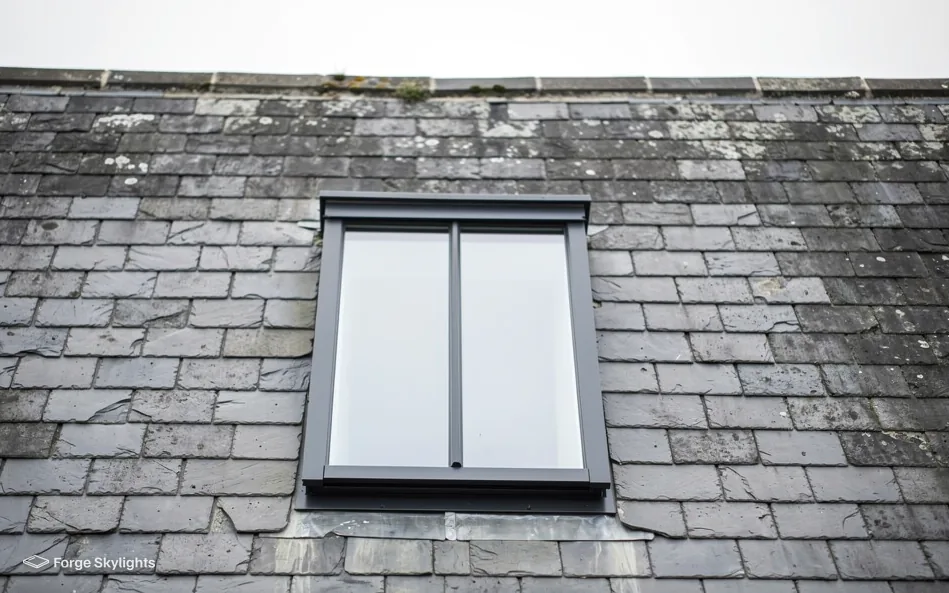
A standard roof window has a deep frame that holds a thick sealed unit with a wide gap between the panes. A conservation rooflight has a thin frame set flush with the roof covering, so the sealed unit is slimmer and the gap between the panes is narrower. The unit is still two sheets of glass with a sealed space between them, and it still cuts heat loss a good deal compared with a single sheet.
Makers fit a slim sealed unit into the narrow frame, and some use a thin spacer at the edge of the glass to reduce heat loss where the glass meets the metal. The right combination depends on the make and the frame material, so the quote sets out the glass specification for each option.
Heat loss and the Building Regulations
Part L 2021, Table 4.2, sets the limits for existing dwellings: a rooflight must achieve 2.2 W/m²K, while the figure for a roof window is the ordinary window standard (1.4 W/m²K), with Window Energy Rating Band B as the other route. The maker's data tells you whether a conservation unit counts as a rooflight or as a roof window, and whichever it is determines which of the two figures it has to reach. Our rooflight U-value guide explains the figures and how the maker states them.
A complete rooflight swap, frame and glass together, counts as a controlled fitting and must be notified, and forming a fresh roof opening is building work too. Changing only the glazed unit leaves the job outside notification. If notification applies to the job, the Building Control side is ours to handle.
A listed building is treated differently, since the Regulations allow for the special character of the building and the building control body weighs it against energy saving. Our answer on consent for a listed building rooflight covers the consent side.
Double glazed heritage units against standard roof windows
A heritage rooflight gives up some thermal performance for its looks, and a standard roof window gives up looks for performance. The table sets the two side by side on the same rows.
| Item | Double glazed conservation rooflight | Standard roof window |
|---|---|---|
| Frame depth | Slim, flush with the covering | Deep, stands above the covering |
| Heat loss | Often higher than a deep-framed unit, within the limit for its type | Lower, within the window limit |
| Look from the street | Closest to an old cast iron rooflight | A modern window in the roof |
| Sightline from inside | Slim frame, more glass | Wider frame and a splay |
| Cost | Usually higher | Usually lower |
If you want to compare the two for a particular roof, our guide to conservation rooflights against roof windows goes through them further.
Triple glazing, coatings and comfort
Slim frames limit the room for triple glazing, so double glazing is the normal choice and the one we price first. Where a maker offers a triple glazed version, it is heavier and thicker and may not suit the slimmest frames, and a listed building's council may not like the extra depth. Coatings do more in many cases. A low emissivity coating on one pane cuts heat loss, and a solar control coating helps keep a south facing loft room cooler in summer.
Laminated glass on the inside is another option and adds safety, though it adds cost. For every option you consider, the written quote spells out the glass specification, which lets you set one option against another directly.
- Glass specification written for each option
- Frame and spacer type named on the quote
- Maker's own warranty on the unit stated
What we check at the survey
The survey takes in the roof structure, the covering and the aspect, and we check the permission position for your address, because what is allowed can be altered by a listing, by a condition on an earlier consent, or by an Article 4 direction, while a conservation area raises the bar on looks. The council decides. After that the written quote lays out several suitable rooflights together, from a choice of makers where the roof permits, and shows, for each of them, the glazing, frame, opening style, price and the delivery time the maker typically gives. Our conservation rooflight cost answer explains what moves the price, and the conservation rooflight page shows the range.
To see the options on your own roof, book a free survey. A 10-year guarantee on our workmanship comes with the job, and the unit has the maker's warranty on top.
Related questions
Is a double glazed conservation rooflight as warm as a standard roof window?
Usually slightly less so, because the frame is slimmer and the sealed unit is thinner. Each unit we quote still clears the Part L figure set for its class, as the maker's data states, and we show the stated figure for each option on the quote.
Can my old single glazed rooflight be changed to double glazing?
Sometimes the sealed unit can be replaced in the existing frame, and sometimes the frame is too slim or worn to take it. We check the frame at the survey and price a whole new rooflight as an alternative.
Will condensation form on a double glazed rooflight?
Any cold surface in a damp room can collect it. Double glazing keeps the inner pane warmer than single glazing, which helps, and a vent or an opening version lets the room air out.
Does double glazing change how a conservation rooflight looks?
The sealed unit is a little thicker than a single pane, but it sits inside the frame and is hard to see from the street. The bar and frame are what the eye picks up.