
Which one suits which roof
Choose a conservation rooflight when the slope is seen from the street, when the council expects a heritage detail, or when you want the opening to sit quietly in the roof. Choose a standard roof window when the slope is hidden, when the roof is modern, or when price and speed matter more than the finest detail. Both are good products. Each gives ground on something the other does well.
A standard roof window, the sort made by VELUX, FAKRO, Keylite and others, is built to be fitted quickly in a wide range of roofs. It has a deeper frame, a flashing kit that dresses onto the tiles and a long list of sizes and opening types. A conservation rooflight is built for roofs where the look matters most. Its frame is thin, it sits level with the covering, and it often carries a single vertical glazing bar.
No single manufacturer ties us down, so the quote sets a suitable conservation rooflight and a suitable roof window side by side wherever the roof allows both. The rest of this page explains each row of that comparison, so that you can read the quote with some confidence. If you need the background on the rules, start with our parent page on conservation rooflights and our guide to rooflights in conservation areas.
Looks and profile
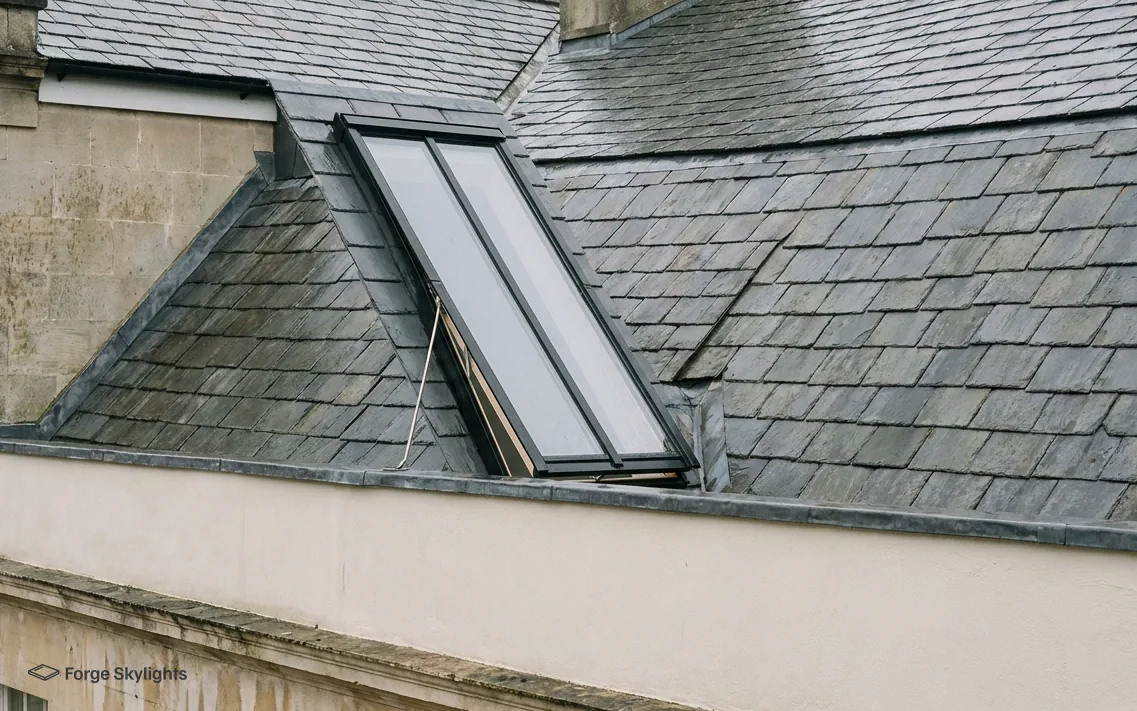
Profile is the difference you see first. A standard roof window sits on a timber or uPVC frame that rises a little above the tiles, with a flashing around it that is visible as a distinct border. From the pavement it reads as a rectangle placed on the roof. A conservation rooflight is set so the glass is close to level with the roof covering, with a slim metal frame that is often finished in a dark grey or black that matches slate or aged clay.
That flush position changes how the unit catches the light. A raised frame throws a small shadow and a bright edge on a sunny day, and the eye is drawn to it. A flush frame gives neither, so the glass looks more like part of the roof. On a Victorian terrace with a long, uninterrupted roof slope, the difference can be large. On a hidden slope at the back of a modern semi, nobody will see it.
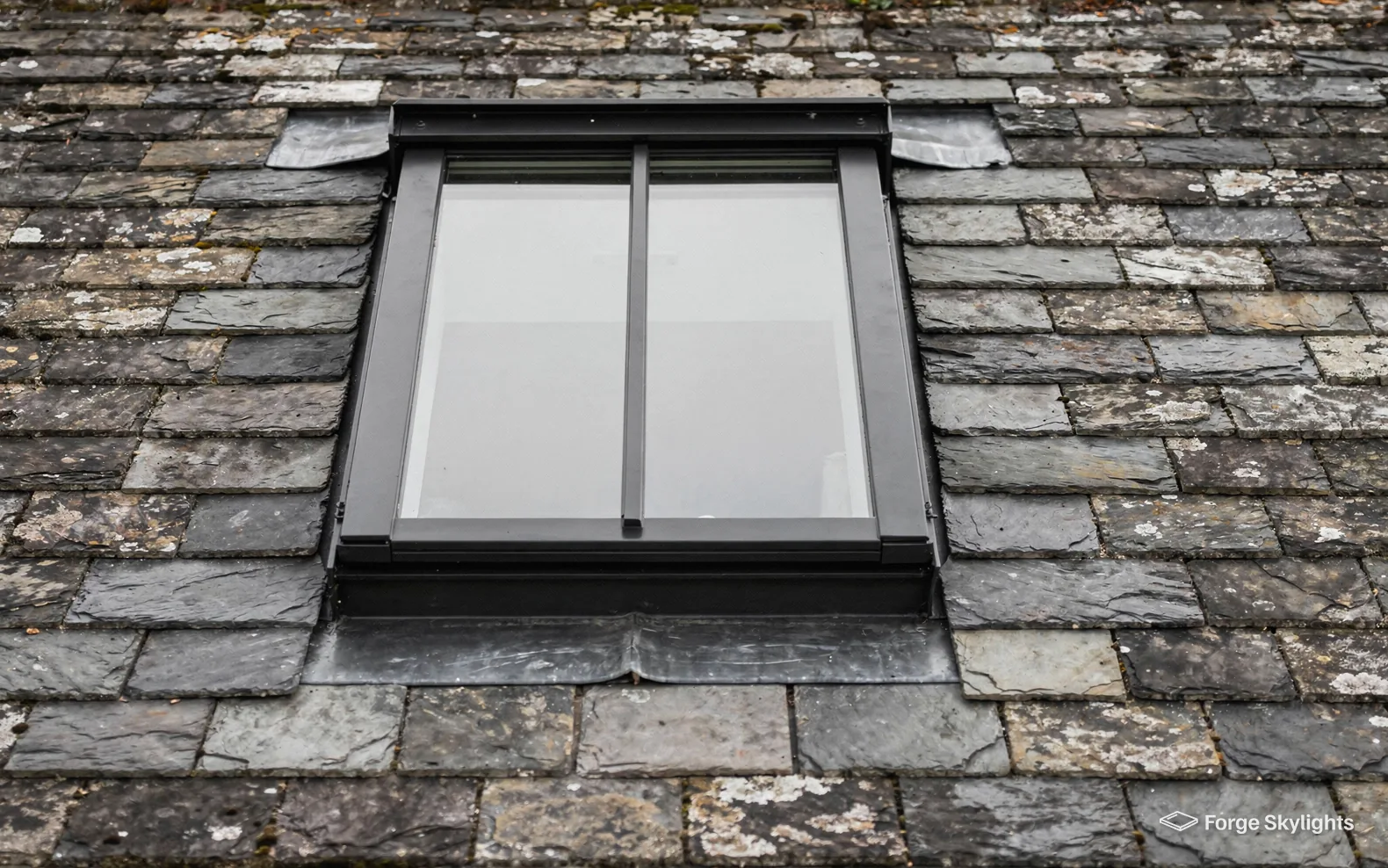
Size and number matter as much as the product. A single larger unit often looks calmer than several small ones, and its proportions can be chosen to sit between rafters in line with the pitch. We mark the proposed position on a photograph of your roof at the survey, so you can judge the effect before you order.
The glazing bar
The most distinctive part of many conservation rooflights is the central glazing bar, a thin vertical member that splits the glass into two panes. It recalls the cast iron rooflights that were fitted to Victorian houses, outbuildings and workshops. Not every conservation rooflight has one, and a standard roof window normally has none.
A bar changes the view from inside as well. It frames the sky in two panels and can interrupt a view of the treetops from a bed or a desk. For some people that is part of the charm, and for others it is a nuisance. We show the bar and bar-free versions together where the maker offers both, and our answer on the conservation rooflight glazing bar covers the choice in more depth.
A central glazing bar splits the glass into two panes, a detail that standard roof windows do not usually carry.
Flashing and how the unit meets the roof
A roof window arrives with a flashing kit made to suit the covering, whether plain tiles, interlocking tiles or slate. The kit dresses the frame to the roof and sheds water around the opening. It is designed for speed and consistency, and on most roofs it works very well.
A conservation rooflight has a lower and simpler flashing, often a thin lead or lead-effect apron, and it relies more on careful cutting of the roof covering around the opening. On clay plain tiles or natural slate this takes more time, because each course around the unit is trimmed and bedded to sit level with the glass. It is part of why the fitting cost can differ, and why the fitter's skill counts.
Ahead of any quote, the covering gets inspected from outdoors and the rafters from inside the roof space. If the tiles are brittle or the slates are slipping, we say so, because the opening and any roofing work around it should be planned together.
Rafter spacing shapes the choice too. Standard roof windows come in many widths, so one can usually be found to sit between rafters with little structural change. A conservation rooflight is made in a narrower set of sizes, and the nearest one may leave a small gap that is trimmed and made good. We note this at the survey and show you the position on the roof before you order, so that the opening, the unit and the finish inside the room all line up.
The two side by side
Here are the same measures for both products, with the rows we use on every quote:
The same rows for each unit
Conservation rooflight
- Profile
- Flush with the covering
- Frame
- Slim, usually metal
- Glazing bar
- Often one, central
- Flashing
- Low and simple, hand dressed
- Thermal figure
- Maker's own, shown on the quote
- Lead time
- Often longer
- Price
- Usually higher
Best on visible slopes and older roofs.
Standard roof window
- Profile
- Raised above the covering
- Frame
- Timber or uPVC, deeper
- Glazing bar
- Normally none
- Flashing
- Maker's kit for the covering
- Thermal figure
- Maker's own, shown on the quote
- Lead time
- Often shorter
- Price
- Usually lower
Best on hidden slopes and modern roofs.
Neither column wins every row. The standard roof window gives ground on looks and wins on cost and speed. The conservation rooflight gives ground on cost and often arrives later, and wins on how quietly it sits in the roof. Some homeowners split the difference, with a conservation rooflight on the front slope and a standard window on the back.
Energy figures, opening and building control
The energy limits come from Part L 2021 and differ between the two products in law. Part L 2021 draws the line in two places: a rooflight has to reach 2.2 W/m²K, whereas a roof window is judged as a window, so it can instead meet Window Energy Rating Band B or come in at 1.4 W/m²K. The maker's data classes each conservation unit as a rooflight or a roof window, and that class decides which of the two limits applies to it. The number to read is the maker's figure for the complete unit, glass and frame together, as it appears on the data sheet.
Slim frames carry less insulation than deep ones, so we compare the published figures on the quote rather than judging by looks. Where a conservation rooflight and a roof window both meet the limit, the better figure is shown, and it can affect comfort in a room that you use through the winter.
Opening is a separate row. Many standard roof windows open on a pivot or a top hung sash, and electric and solar-powered versions exist. Conservation rooflights can be fixed or opening, and the opening ones tend to use a top hung or side hung sash or a pivot that keeps the slim profile. Escape is a different matter: an exit through a roof window is possible only from a bungalow or chalet bungalow loft room, inside the height Approved Document B sets, while a loft conversion on a house of two storeys is served by a protected stair.
Notifiable work
An entire replacement unit counts as a controlled fitting, so it must be notified, and forming a brand-new roof opening is building work as well. Whenever the job falls under notification, the Building Control paperwork is ours to deal with. Replacing only a sealed glass unit is not notifiable.
Planning, lead time and price
The planning position depends on the address and not on the product. In a conservation area, the conditions in our rooflight planning guide still apply, and a council may have withdrawn permitted development for your street. Where the building is listed, you apply to the council for listed building consent before anything else, and that holds for either type of unit. First we look into the address; after that the call belongs to the council. The cost of each route is outside the product price, so we state it separately.
Lead time follows how the unit is made. Standard windows are produced in stock sizes, so they often reach site sooner. Conservation rooflights are frequently made to order, so the quote gives lead time as the range that the maker normally quotes. A delivery date goes in writing once the maker has confirmed it.
On price, a conservation rooflight usually costs more than a roof window of a similar size, because of the frame, the making and the more careful fitting. The gap varies by maker and size, and the quote shows both side by side, with the fitting included on each line. Our answer on how much a conservation rooflight costs explains the pieces of the figure.
Choosing for your roof
Here is how we help you decide, in the order we do it:
See the slopes
Which slopes the street can see, and which are hidden behind the house or its neighbours.
Check the rules
Conservation area, listing, Article 4 direction or planning condition for your address.
Match to the roof
Covering, rafter spacing and pitch, to see what size and position the roof allows.
Compare on paper
Each of the two units priced on matching rows, with several makers set against each other where the roof has space for more than one make.
You choose
A conservation rooflight, a roof window, or one of each for different slopes.
The free survey covers all five steps, and the written quote after it sets out the 10-year workmanship guarantee we give, with the maker's separate warranty on the unit itself. Our area is Birmingham and everywhere within 30 road miles of the city.
To see the pair for your roof, book a free survey and we will put them next to each other on paper.
Common questions
Is a conservation rooflight really different from a roof window?
Yes in how it is built and how it looks. It has a slimmer frame, sits flush with the covering and often carries a central glazing bar, where a standard roof window has a deeper frame and a flashing that stands proud.
Which one will the council prefer?
On a slope the street can see, slim flush units tend to sit more easily with conservation officers. Decisions vary by council and by roof, so the council decides, and we check your address before you order.
Why does a conservation rooflight usually cost more?
The frame is slimmer and more finely made, the maker often builds to order, and the covering around it is cut and dressed by hand. The quote shows both products on the same lines so the gap is clear.
Can I mix the two on one house?
Yes. A conservation rooflight on the visible front slope and a standard roof window on the hidden rear slope is a common pairing, and we price it that way if you ask.
Do both meet the energy rules?
Each quoted unit has to clear Part L 2021 in full: 2.2 W/m²K applies to anything classed as a rooflight, while anything classed as a roof window instead has to reach Band B on its rating label or a U-value no worse than 1.4 W/m²K. The maker's own figure for the complete unit is printed on the quote.