The short answer
A sun tunnel price is built from five parts: the tube diameter and length, whether it is rigid or flexible, the roof flashing, the ceiling diffuser, and any extras such as a light kit or an extension to the run. On your written quote each part is priced for more than one suitable tunnel, which shows you where the cost sits.
Diameter and length of the tube
A sun tunnel is a roof dome, a reflective tube and a ceiling diffuser, and the tube is the part that varies most from one house to the next. A wider tube carries more light and costs more. A longer tube needs more material and more careful fitting, and it also loses more light on the way down, which is a reason to keep the run short and straight where possible.
The length depends on the roof space. A tunnel for a hallway under a shallow loft is short. One that has to pass through a deep loft and an insulated floor is longer, and may need an extension section on top of the standard kit.
Our guide to sun tunnels and skylights explains how a tunnel compares as a light source, and the main sun tunnels page covers the types.
Rigid or flexible tube
A rigid tube has a mirror-finish lining and carries light further, so it is the usual choice for longer or brighter runs. A flexible tube can bend around a rafter or a duct, which makes it useful where a straight run is not possible, but the folds in the tube take light with them. Our guide to rigid and flexible sun tunnels compares them at length.
| Item | Usually lower | Usually higher |
|---|---|---|
| Tube | Flexible, short | Rigid, long |
| Diameter | Narrower | Wider |
| Roof flashing | Standard kit for the covering | Special kit or extra roof work |
| Diffuser | Standard opal | Decorative or with a light |
| Extras | None | Light kit, extension or vent |
Price differences between the two tube types depend on the size and the make, so the rigid and flexible versions of the same diameter are priced together on the quote. A rigid tunnel can cost more, but if it lets in more light in a dark hall, it may be the better value.
Roof flashing and the dome
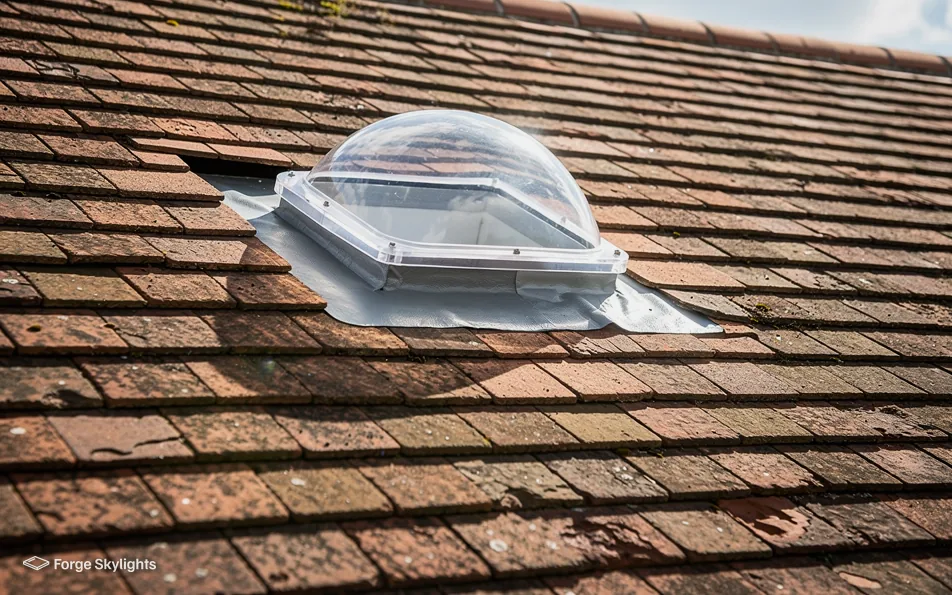
The roof end of a sun tunnel is a dome on a flashing that has to match the roof covering. Flashings are made for plain tiles, profiled tiles, slate and flat roofs, and their prices differ from one covering and one maker to the next. The dome is clear, and some makes offer a tougher or better insulating dome as an upgrade.
Pitch is a factor too. Makers set a range of roof pitches that each model suits, and a roof outside it needs a different flashing or a different product. Our answer on fitting a sun tunnel to a flat roof explains what changes when the roof is flat.
The diffuser, the ceiling and extras
At the ceiling the tunnel finishes in a diffuser that spreads the light. A plain opal diffuser is the starting point. A decorative or recessed one costs more, as does a diffuser with a built-in light for use at night, which also needs an electrician for the wiring.
Cutting the opening in the ceiling and making good around the diffuser is part of the job, and decorating is usually left to you; the quote says so. Some tunnels also take a ventilation kit, which adds to the cost and is a separate choice from the light. Where the tunnel passes through an insulated loft floor, the insulation has to be kept around it.
- Tube priced by diameter and length
- Flashing matched to the roof covering
- Diffuser and extras on their own lines
What makes a quote differ from the next
Two sun tunnels of the same diameter can differ in price because of the roof covering, the length of run, the type of tube and the diffuser. A tunnel in a bungalow with a short run is a small job. One passing through a two-storey roof space, past ducts and pipes, is a different one.
Cutting the roof for a tunnel dome is building work in Building Regulations terms, and the Building Control notification, where one applies, is ours to handle. The quote includes it. Planning is rarely a worry for a roof dome, though it depends on the property, and the conditions are in our rooflight planning guide.
If you are still choosing between a tunnel and a roof window for a dark hallway, our answer on a sun tunnel for a hallway compares the two. If you want to go ahead, book a free survey, and we will measure the run, then price suitable tunnels one beside another.
Related questions
Is a rigid sun tunnel dearer than a flexible one?
For the same diameter it usually costs more, though the light it carries often makes up for it on a long run. Both are priced on the quote whenever both would suit the roof.
Does a sun tunnel quote cover the Building Control notification?
Where the work is notifiable, yes. The notification is something we do ourselves, and its cost sits in the quote.
Does a longer tunnel always cost more?
It does, because it needs more tube and more fitting time. A short, straight run usually costs least and carries the most light, so we look for the shortest route through the roof space at the survey.
Can I add a light to the tunnel later?
Often, yes, if the diffuser can take one. It is cheaper to plan it at fitting, because the wiring has to reach the ceiling.