
Which one suits the room
Choose a sun tunnel when the room has no outside wall to borrow light from and the loft space above it is full of rafters, joists, insulation or storage. Choose a skylight, or rooflight in the trade's word, if you want to see the sky, to let fresh air in through the roof or to get a good deal more daylight than a tube can carry. That is the quick verdict, and the rest of this guide explains the reasoning behind it so you can test it against your own house.
A sun tunnel has three parts: a small dome up on the roof, a reflective tube running through the loft and a diffuser set into the ceiling. It sends daylight to a hallway, a landing, a bathroom or a wardrobe that would otherwise need a lamp switched on all day. A skylight is a glazed unit in the slope or flat roof, with a lined shaft or a sloping ceiling beneath it. It lights the room in the same way a window would, and many models open.
At the survey we put both on the same quote wherever the roof and the loft allow, from more than one maker, and we show what each would do in the room. The sections below are the measures we go through with you. If you already know you want a tube, our hub on sun tunnel installation covers the range, and if you are leaning towards a window, roof window installation does the same.
Light: how much and what kind
A skylight has the larger glass area, and in most rooms it gives the greater amount of daylight. The light is also direct, so you get shadows, bright spots of sun on the floor in the morning or afternoon, and the feeling of being under the sky. A sun tunnel gathers light from a dome that is much smaller than a window. The tube loses some along the way, and the diffuser spreads the rest evenly across the ceiling. The result is soft and shadowless, closer to a bright ceiling light than to a window.
That difference suits some rooms and not others. In a windowless hallway, a tube can turn a gloomy space into one that needs no lamp on a bright day, and the soft spread is exactly right. In a bedroom or a study, where you want to read, look out and judge the weather, a skylight is nearly always the better choice. In a kitchen, a skylight over the worktop gives you better light to work by, though a tube works well over a pantry or a utility room.
A tube also follows the sky less closely. On a dull day it carries less, and in the evening it fades quickly, which can feel abrupt in a room used mostly after work. A skylight is not any better after dark, but it shows you the dusk and a bright moon, and many people value that more than the lumens.
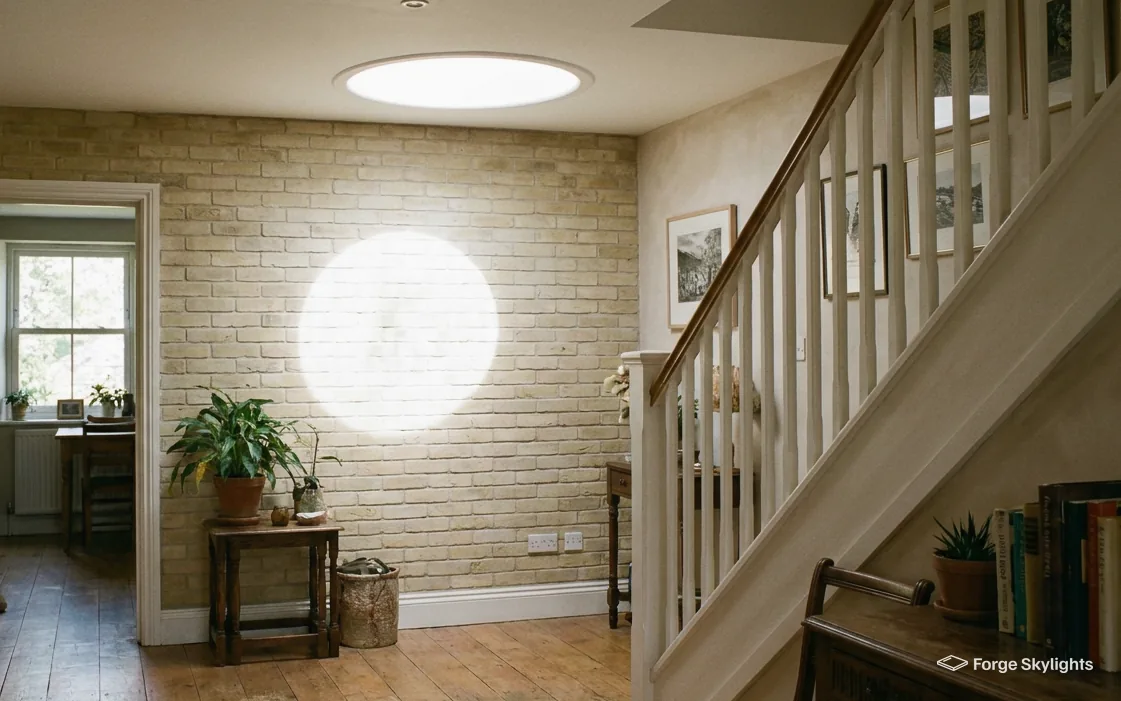
Some tubes can take a light fitting or a lamp kit in the diffuser, so the same ceiling circle works after dark. That adds a little to the price and is worth thinking about for a room used mostly in the evening.
The view and fresh air
A sun tunnel has no view. The diffuser is frosted or prismatic glass or plastic, so you see light and no sky. If a view out matters in the room, a tube is the wrong tool and a skylight is the right one, whether it is a roof window in a pitched roof or a flat rooflight on an extension.
Ventilation follows the same line. A standard skylight can open, and an electric or remote-controlled one can close itself when its rain sensor picks up rain. A tube is normally a fixed, sealed system. Some makers offer a ventilation kit that adds a vent in the diffuser, which suits a bathroom or a utility room, and the maker's data says whether the kit suits the model on the quote. Our page on electric opening rooflights covers what a powered window adds.
Bathrooms
A tube is a popular bathroom choice because it lights the room without a window that overlooks the garden. If the bathroom also needs better ventilation, we price a tube with a vent kit next to a small opening skylight, so you can compare the two on the same quote.
The space needed in the loft
The biggest practical difference is what happens between the roof and the ceiling. A skylight needs a lined shaft or a sloping lining from the roof opening down to the ceiling, so the opening above the room has to be roughly in line with the opening in the ceiling. Where the loft is deep, that means a wide light shaft that takes floor space in the loft. Where the roof slopes, the lining runs diagonally, and rafters may need trimming to make the opening.
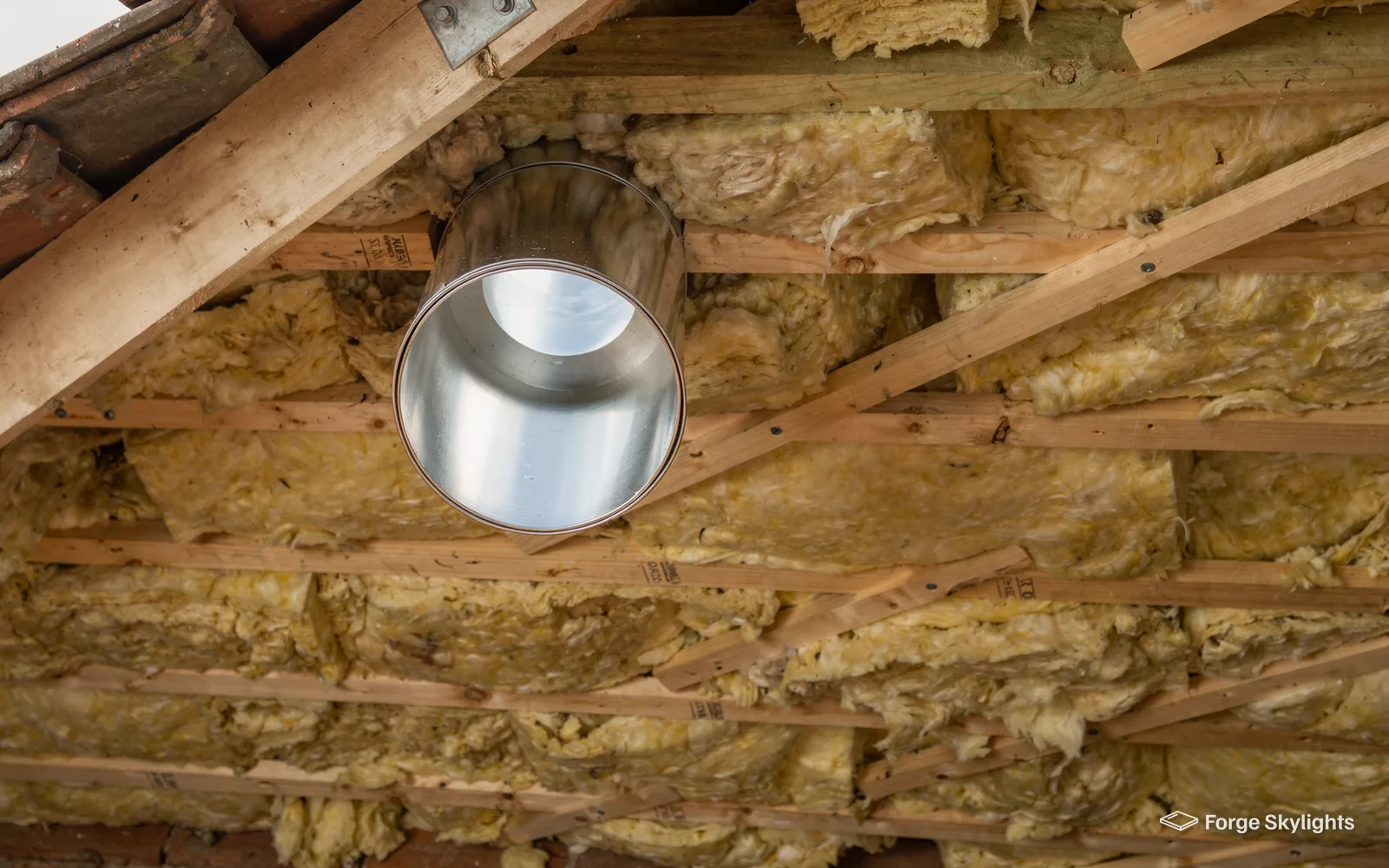
A tube is a pipe, usually a few tens of centimetres across at most. It runs from the dome to the ceiling and can bend, if the tube is flexible, to dodge a rafter, a water tank or a run of insulation. A rigid tube is straight and brighter, and a flexible tube is easier to fit around obstructions. Our guide to rigid and flexible sun tunnels sets them out side by side.
What each needs in the loft
Sun tunnel
- Roof opening
- Small, often between rafters
- Loft space
- A narrow run for the tube
- Rafters
- Usually left uncut
- Ceiling
- A round hole for the diffuser
Easier where the loft is full or the room is far from the roof.
Skylight
- Roof opening
- Sized to the unit, often with rafters trimmed
- Loft space
- A lined shaft or sloping lining
- Rafters
- Often trimmed and framed
- Ceiling
- A larger opening, finished and decorated
Easier where the room sits directly under the roof, as in a loft conversion.
We check the loft before either option is quoted: where the rafters and trusses run, whether there is a water tank or a duct in the way, how thick the insulation is and how far the room sits from the nearest part of the roof. A long run from a distant roof opening to the ceiling loses light, which is another reason a skylight suits a room directly under the roof and a tube suits one set further in.
Heat, glare and condensation
Heat gain and heat loss both track glass area. A skylight has more of it, so it lets in more sun in summer and loses more heat in winter than a tube does. Modern units reduce both with coated, double or triple glazed panes, and a solar control coating is the usual answer for a south or west facing room. Our page on solar control rooflight glass explains how that works.
A tube has a small dome and a diffuser, and some makers fit a double skin to the dome and a sealed diffuser to cut condensation and heat transfer. The tube passes through the loft insulation, so the insulation is carried around it, and the diffuser sits below it. The glazing area is so small that gain and loss are small as well, which suits rooms that are cold already, such as a north facing landing.
Regulations first: Part L 2021 gives a rooflight going into a lived-in house a ceiling of 2.2 W/m²K, whereas a roof window answers to the window standard, which it meets either through WER Band B or through 1.4 W/m²K. We read the maker's figure for each unit on the quote and show it next to the others. Sun tunnels are tested differently from glazed units, so Building Control decides how Part L applies to one, and we pass on the figure the maker states.
Condensation can form on cold glass in a humid room such as a bathroom, whichever you choose, and ventilation is the most reliable way to keep it down. We suggest the extraction that suits the room alongside the glazing. Our page on rooflight condensation goes further.
Fitting, mess and the roof
A tube is the lighter job. The roof opening is small, the tube is threaded through the loft and the ceiling hole is round and tidy, so there is little structural work and less dust below. Fitting normally goes more quickly than for a skylight, and it is often done without disturbing the room much. A skylight involves a larger opening, trimmers or a framed shaft, and plastering and decorating the lining, so more trades are involved and the room is disturbed for longer.
Both are weathered in the same careful way: the dome or the frame is flashed into the roof covering, and the flashing kit is chosen to suit the tile, slate or flat-roof covering. On a flat roof, a tube needs a base and a kerb, as covered in our page on sun tunnels on a flat roof, and a flat rooflight needs an upstand. For a pitched roof, a roof window uses a flashing set to the covering profile, and our page on roof windows on a low pitch covers the shallow cases.
Replacing an old unit is a separate case. A whole new rooflight or roof window going in, frame and glass together, must be notified under the Building Regulations, and forming the opening itself counts as building work as well, so we arrange the Building Control notification wherever the job needs one. We also check the position for your address, since permission depends on conditions that apply to rooflights in general. Our rooflight planning guide sets them out, and our answer on sun tunnel planning permission covers the tube side. The council decides.
Price and the two compared
A sun tunnel usually costs less than a skylight, because the unit is smaller, the opening is small and the finishing is minimal. A skylight usually costs more, and a larger one, an opening one or a powered one costs more again, so the total depends on size, glazing, the flashing kit, the lining and the decorating. Our answer on what a sun tunnel costs breaks the figure down, and our page on roof window fitting cost does the same for the window.
| Item | Sun tunnel | Skylight |
|---|---|---|
| Light | Soft and even, less of it | More, direct and changing |
| View of the sky | None | Yes |
| Fresh air | Fixed, or a vent kit | Many models open |
| Loft space used | A narrow run for the tube | A lined shaft or a sloping lining |
| Rafters | Usually left uncut | Often trimmed and framed |
| Heat gain and loss | Small, from a small area | Larger, reduced by coatings |
| Fitting | Lighter and quicker | More involved, with lining and decorating |
| Price | Usually lower | Usually higher |
A sun tunnel needs a narrow run through the loft, where a skylight needs a lined shaft.
The table shows the tendencies, and your roof may be an exception. A large tube can cost as much as a small skylight, and a simple fixed skylight can cost little more than a good tube. The written quote gives the real figures for the options on your roof, with the lead time as the maker's typical range.
Room by room, then the survey
Rooms tend to sort themselves quickly once the measures are laid out. A hallway or landing with no window leans towards a tube, as our page on a sun tunnel for a hallway explains. A bathroom leans towards a tube, or a small opening skylight if ventilation matters. A bedroom or a study leans towards a skylight for the view and the air. A kitchen leans towards a skylight over the work area. A walk-in wardrobe or a pantry leans towards a tube. A loft room used as a bedroom leans towards a roof window, with the escape rules in mind.
A few homes use both, and it is a sound pairing: a skylight in the main room under the roof, and a tube for the hall or bathroom below it, where the loft is too crowded for a shaft. We price the pairing as a single job so the roof work is done once.
Walk the rooms
Which rooms need light, which need a view and which need fresh air.
Look at the loft
Rafters, trusses, tanks, ducts and insulation between each room and the roof.
Check the roof
Covering, pitch and aspect, so we know what the flashing and the glazing need to do.
Set the options out
Tube and skylight, or both, from more than one maker, with price, lead time and the maker's warranty side by side.
Our free survey covers all of that, and the written quote that follows has no obligation. Fitting follows current Building Regulations, and our own work is covered by a 10-year workmanship guarantee. Book a free survey and we will lay the two out for your own rooms.
Common questions
Is a sun tunnel as bright as a skylight?
A skylight generally lets in more daylight because its glass area is larger. A sun tunnel gives a softer, more even light, which suits a hallway, a landing or a bathroom well but is less bright than a window of similar visible size.
Can I get fresh air from a sun tunnel?
A standard tube is sealed. Some makers offer a vent kit for the diffuser, and a small opening skylight is the other route. We check the options for your room and put them on the quote together.
Which is easier to fit where the loft is full of storage?
A sun tunnel, since it needs only a narrow run between the roof and the ceiling, and a flexible tube can go around obstructions. A skylight needs a lined shaft, which takes more of the loft.
Do both need permission?
Either one is often permitted development, though the tests set out in our rooflight planning guide have to be met. Listed buildings are different, and so are homes where permitted development has been withdrawn, by way of an Article 4 direction, or of a condition attached to the planning permission, which is why your address gets checked and the council decides.
Will a skylight make a room too hot in summer?
A large south or west facing skylight can add heat. Solar control glass, a blind or a smaller unit reduces it, and we price the glazing choices side by side.
Can I add a skylight later if I fit a sun tunnel now?
Usually, if the roof and the loft have room for it. We note the loft layout at the survey so a later change is easy to plan.