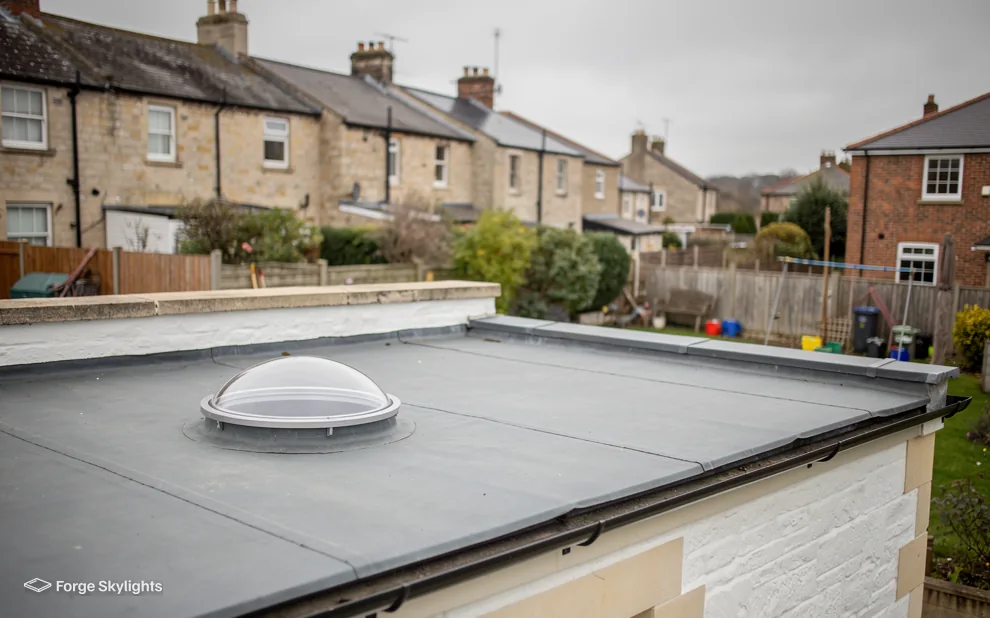
The short answer
Yes, a sun tunnel can be fitted in a flat roof. The dome sits on a raised upstand, which is built into the roof and dressed with the waterproof covering, and the tube drops from there to a ceiling diffuser. For a small room a compact flat rooflight is the other choice, and we price the two side by side.
How a tube goes through a flat roof
On a pitched roof the dome sits in a flashing that overlaps the tiles. A flat roof has no tiles to overlap, so the dome is carried on a short upstand, a raised collar around the opening, and the roof covering is turned up its sides and sealed. The upstand lifts the dome clear of standing water and gives the covering something to finish against.
A flat roof also has a deck, joists and often a layer of insulation, so the tube passes through more build-up than it would in a loft. That build-up is part of what the survey measures, because the tube has to run from the dome to the ceiling in a straight line where it can.
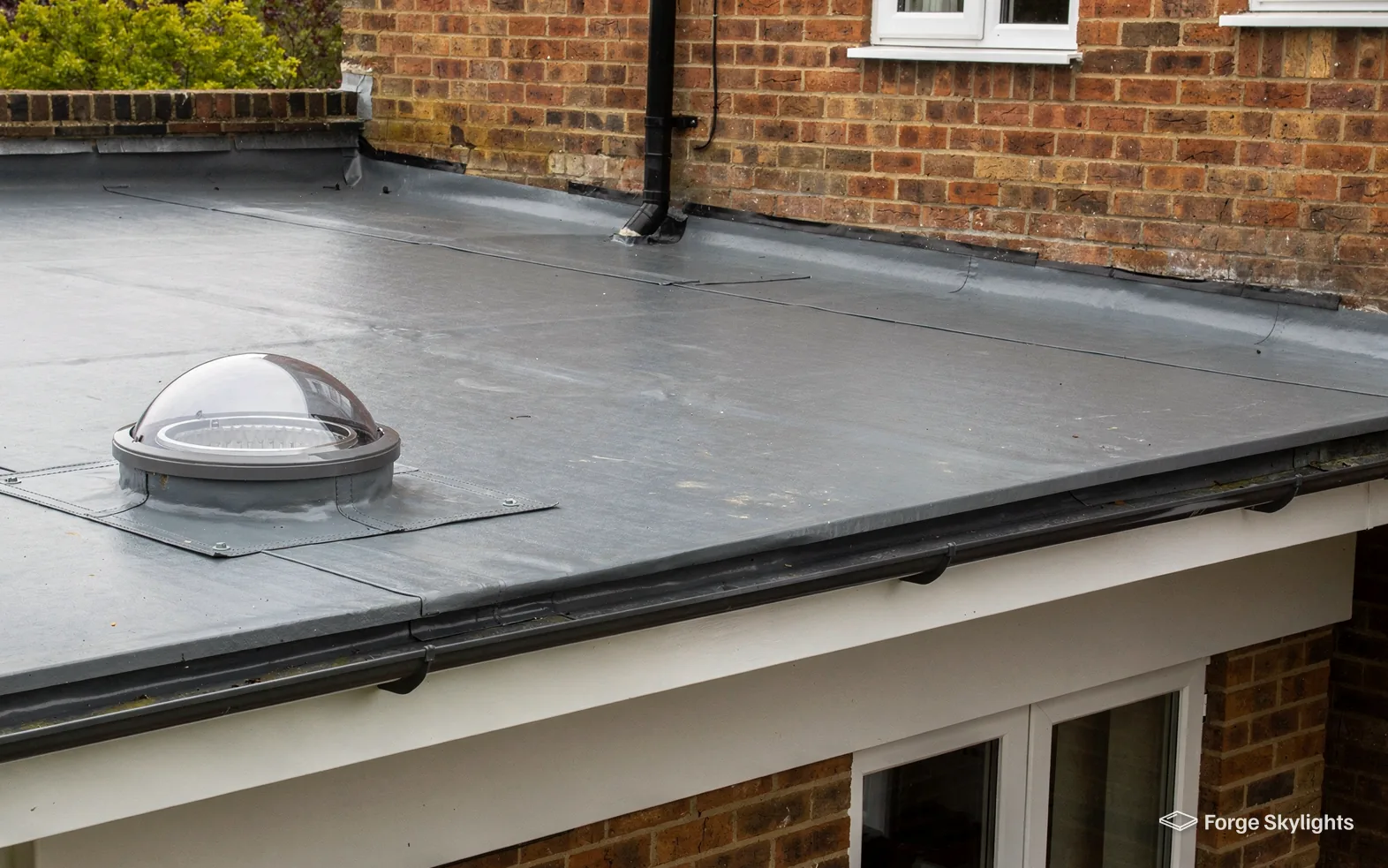
What the roof covering changes
The covering decides how the upstand is finished. A single ply membrane, a fibreglass roof or traditional felt each has its own way of being joined to a new upstand, and the joint is the part that keeps water out for years. We match the method to the covering you already have, which is why we ask about it at the survey. Our guide to rooflights on EPDM, GRP and felt roofs goes through each in turn.
A covering close to the end of its life is a poor place to cut for a new dome, because re-covering the roof soon afterwards can mean paying twice for the same edge. In that case it may be sensible to time the tube with a new covering, and we say so in the quote rather than leave you to find out later.
Our answer on flat rooflight upstands explains how the raised collar is built, and it applies to a tube dome as much as to a rooflight.
A sun tunnel or a small flat rooflight
The two solve the same problem differently. A tube carries light along a pipe and spreads it from a ceiling diffuser, so it can reach a room that is not directly under the roof. A flat rooflight sits straight above the room and lets the sky in through a pane, so you see the sky as well as the light.
| Item | Sun tunnel | Small flat rooflight |
|---|---|---|
| Light | Soft, from a round diffuser | More, with a view of the sky |
| Opening in the roof | Small | Larger |
| Ceiling work inside | A diffuser ring | A lined light well or kerb |
| Fresh air | None | Available with an opening version |
| Cost | Usually lower | Usually higher |
| Best for | Rooms off to one side of the roof | Rooms directly below the roof |
A flat extension with a loft-free ceiling and a small room below, such as a utility room or a corridor, often suits the tube. A kitchen or a family room that sits directly below the roof usually gets more from a rooflight. Our flat roof rooflights section compares the types, and our answer on a sun tunnel against a skylight covers the general choice.
Insulation, condensation and the building rules
A tube crosses the warm side and the cold side of the roof, so it needs insulation around it and a dome that is sealed against moisture. We choose a tube with an insulated collar and a sealed diffuser, and the tube is wrapped as the maker's installation guidance directs.
A new opening cut in a flat roof is treated as building work by the Building Regulations. Notifiable jobs have the Building Control notification sent by us, and the fitting follows current requirements. A sun tunnel is tested differently from a flat pane of glass, so Building Control decides how Part L 2021 applies to it, and the maker's published thermal figure for the unit goes on the quote.
Permission is a separate question. A dome standing proud of a flat roof may come under permitted development, provided it meets the tests laid out in our rooflight planning guide. Your address is looked at by us first, and the decision belongs to the council.
Before you book a survey
On a flat roof we look at the covering, the build-up through the deck, the route from roof to ceiling and the room below. Next, a tube and a flat rooflight of suitable size are laid out together, with several makers compared if the roof can take them, and the glazing, frame, opening and lead time shown on the same lines.
- Covering type and age noted
- Tube route and build-up measured
- Tube and rooflight priced side by side
Book a free survey and the written quote sets out both. Our guide to sun tunnels covers the products in more detail, and the manufacturer's warranty covers the product while our own 10-year workmanship guarantee covers the fitting.
Related questions
Does a flat roof sun tunnel leak more easily than a pitched one?
The upstand and the joint to the roof covering decide that, not the roof shape. A correctly built upstand with the covering turned up its sides is sound, and we match the joint to your covering.
Can the tube go through a flat roof with a warm deck?
Yes, with an insulated collar through the build-up. The survey confirms the layers and the tube route first.
Can I choose a rigid tube on a flat roof?
Where the run is straight, yes, and it gives the most light. Where the route needs a bend, a flexible section may be the sensible choice.
Will a sun tunnel look odd on my extension roof?
A low clear dome on a neat upstand is a modest feature. A flat rooflight on a kerb is larger, and the survey helps you compare how each looks from the garden.