The short answer
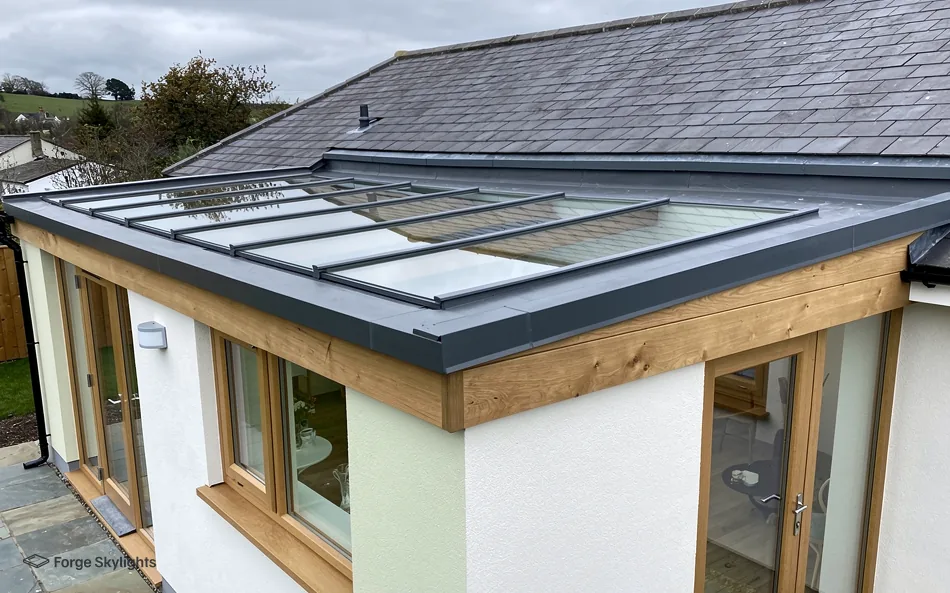
A flat rooflight needs the water on its glass to run off, so the glass must lie at a slight fall rather than dead level, and each maker states the minimum fall for its own unit. The roof can be close to level because the upstand, or the shape of the unit, provides the fall, and the survey checks the maker's figure against your actual roof.
Why a flat rooflight cannot be level
Rain on a glass pane that lies perfectly level has nowhere to go. It sits, dries in rings and leaves a film of dirt, and over time standing water can work at the seals around the edge. A slight fall lets the water run off the glass and carry some of the dirt with it. That is true of a skylight on a flat roof just as it is of the roof around it.
The word flat is trade shorthand. A flat roof is built with a fall towards a gutter or an outlet, and a flat rooflight is a low glazed unit that goes into such a roof. Nobody expects the glass to be horizontal, and the makers' data sheets give a minimum angle that the glass has to achieve once it is fitted. Our hub on flat roof rooflights introduces the full range of units.
Where the fall comes from
There are three usual sources, and a roof can use more than one.
- The roof itself. The deck has a fall built in, so a unit set on a level upstand simply follows the angle of the roof.
- The upstand. A kerb or insulated upstand can be made higher on one side, so the glass tilts even where the deck is almost level.
- The unit. Some flat rooflights have a glass pane that is shaped or bedded to give its own slope, whatever angle the roof underneath has.
Which source is used depends on the roof and on the unit. A site-built timber kerb is easy to cut with a taper, since the carpenter can set each side to height. A factory upstand is made to the maker's own shape, so the tilt is part of the design, and the maker states how steep the roof must be for it to work. Our guide to flat rooflight upstands sets the two side by side.
Fall from the roof or from the upstand
Two ways to give the glass its fall
Roof fall
- Where the angle comes from
- The deck and its screed or insulation
- Upstand
- Level all round
- Good for
- Roofs with a clear fall already
- Watch for
- Roofs that settle or pond
The simplest build when the roof already has enough fall.
Tilted upstand
- Where the angle comes from
- A kerb built higher on one side
- Upstand
- Tapered or stepped
- Good for
- Nearly level roofs
- Watch for
- A taller edge visible from the garden
Gives the glass its own fall where the deck has little.
Each has a cost. A tilted upstand adds work to the kerb, and the higher side can show from the garden. A level upstand on a roof with too little fall can leave the glass short of the maker's minimum, so we measure the roof at the survey and set the upstand to suit.
What we check on a roof with almost no fall
Some extension roofs are laid very close to level, or have sagged or settled in places. Before suggesting a unit we look at which way the roof falls, where the water drains to, and whether it ponds anywhere near the proposed opening. A rooflight sitting in a hollow collects water around its upstand, which no choice of glass can put right.
- Direction and amount of fall at the opening
- Where water leaves the roof
- The maker's stated minimum for each unit
Where the fall is poor, the options are a tilted upstand, a unit made for shallow roofs, or a change to the roof's own fall with the covering renewed at the same time. On the quote the choices sit next to each other, with more than one maker included where the roof suits, which shows what each one adds. Our answer on rooflights for EPDM, GRP and felt roofs covers how the covering is joined once the upstand is set.
Your quote and the maker's minimum
The minimum fall belongs to the maker and varies from one product to the next, so no single pitch fits every rooflight. It is on the maker's data sheet and in their fitting instructions, and the written quote carries it for each option, so you can see which unit suits a roof with a gentle fall and which asks for more.
Fitting a rooflight to a manufacturer's instructions also matters to the warranty on the unit, and that sits alongside our 10-year workmanship guarantee. A new opening counts, for Building Regulations purposes, as building work, and the job's Building Control notification, if it needs one, is something we handle.
If you are working out what else sets the price of a flat rooflight, our guide to flat roof rooflight cost lists the parts. To have the fall on your own roof measured, book a free survey.
Related questions
Can a rooflight go on a completely level roof?
A roof built dead level is unusual, and the glass still needs a fall. A tilted upstand or a unit made for shallow roofs can provide it, and the survey tells us which is needed.
Will standing water on the glass harm a rooflight?
Water that sits on glass leaves rings and dirt and can stress the seals at its edge over time. A fall that lets it run off keeps the glass cleaner.
Does a self-cleaning coating change the pitch needed?
The maker's minimum still applies. The coating helps rain wash dirt away, and it works best where water actually runs off the glass.
Who decides the fall, you or the roofer?
The maker's minimum sets the limit, we measure your roof against it, and the upstand and covering are agreed in writing before anything is ordered.