The short answer
The price of a flat roof rooflight is set by the unit itself (size, glazing and whether it opens), the upstand it sits on, the roof covering that has to be joined to it, any work to the structure, and the finish inside. A new roof prices most of this in one go, while an existing roof adds the cost of working around what is already there.
The rooflight unit
The unit is usually the biggest single line. Size is the first driver: a larger pane costs more, and the step up is rarely even, because a big sealed unit needs thicker glass and a stronger frame to carry it. A skylight made to a special size costs more than one from the maker's standard range.
Glass is the second driver. Double glazing is the starting point, triple glazing adds cost and weight, and a solar control or self-cleaning coating adds a little more. A frameless unit, where the glass is the main thing you see, generally costs more than a framed unit of the same size. Our guide to frameless flat rooflights sets the two side by side.
| Item | Usually lower | Usually higher |
|---|---|---|
| Size | Maker's standard size | Made to measure |
| Frame | Framed | Frameless |
| Glass | Double glazed | Triple glazed or coated |
| Opening | Fixed | Hand or electric vent |
| Upstand | Timber kerb built on site | Factory insulated upstand |
Fixed or opening
A fixed rooflight lets in daylight and nothing else, so it costs least. An opening one adds hinges, a handle or a pole, and the sash is heavier. An electric vent costs more again, because it needs a motor, a rain sensor if you want one, and a power supply run to the upstand. That wiring is priced as its own line on our quote.
Where the room is a kitchen or a bathroom, the extra for an opening unit often earns its place, since steam and warm air rise to the highest point. In a dining area with doors on two sides a fixed unit may be all you need. Our page on electric and opening rooflights compares the controls, and our guide to electric rooflight cost covers the motor and wiring lines.
The upstand and the roof covering
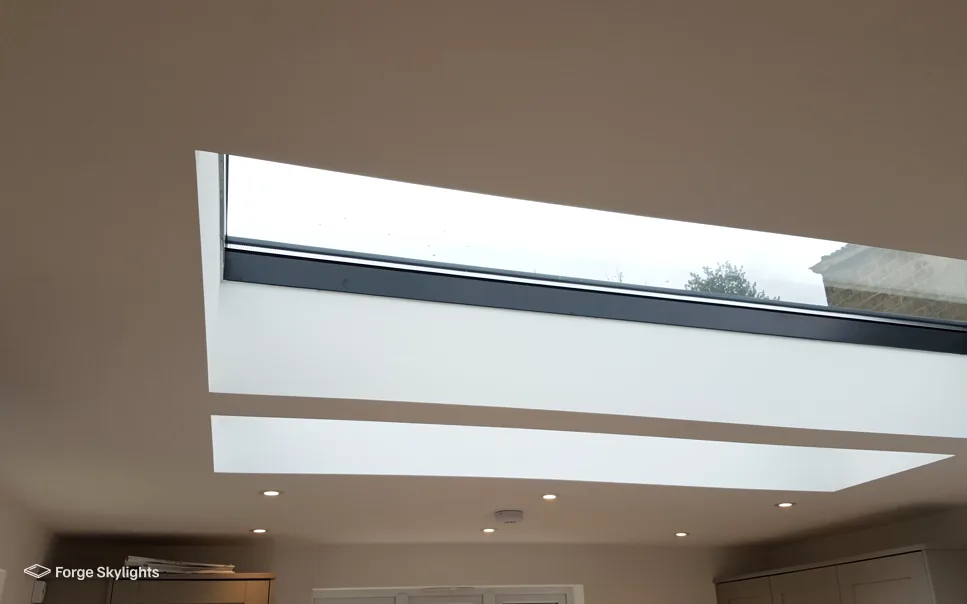
A flat rooflight sits on an upstand, a raised frame that lifts the glass clear of the roof surface. A timber kerb built on site usually costs less than a factory insulated upstand, though the factory version gives a squarer edge and continuous insulation. Our guide to flat rooflight upstands explains the trade.
The roof covering then has to be joined to the upstand. On a new roof the covering and the upstand are dressed together, so this is a modest line. On a finished roof the covering must be cut back and the new junction formed, and the cost depends on what the covering is. EPDM, GRP and felt each have their own method, which our answer on rooflights for EPDM, GRP and felt roofs describes. If the existing covering is nearly worn out, renewing it around the new rooflight can be the better plan, and the quote lists that as a separate line so the decision stays yours.
Structure, Building Control and the finish inside
A new opening wider than the gap between two joists means cutting joists and fitting trimmers. That structural work, and any calculation it needs, is priced separately. A large unit or two units side by side can add steelwork, which is one reason the size you choose changes more than the price of the glass.
Forming a new opening in a flat roof is building work, and the regulations say that a like-for-like swap of the entire rooflight counts as a controlled fitting and must be notified. On notifiable jobs we send Building Control its notification, and the cost sits inside the quote. A rooflight going into an existing dwelling must come in at 2.2 W/m²K or better under Part L 2021, so any unit with a poorer figure is left off the quote.
Inside, the upstand is lined, insulated and plastered so the light well looks part of the ceiling. A deeper well costs more than a shallow one. Decorating normally stays with you and the quote states it, while plastering made good and painted can be added if you ask at the survey, and it is then priced as its own line.
Why the survey comes before the price
Two rooflights with identical dimensions can differ a great deal once the glass, upstand, covering and structure are counted, and the roof decides much of it. Naming a price before the roof has been seen would only be a guess. Nothing is charged for the survey, and the written quote itemises every part of each option, with different manufacturers compared if the roof can take them.
- Each rooflight priced line by line
- Upstand and covering shown separately
- Lead time from the maker for each option
If you are weighing a flat rooflight against something taller, our answer on a roof lantern or a flat rooflight compares the two, and our hub on flat roof rooflights shows the whole range. To get numbers for your own flat roof, book a free survey and the units that suit it are priced next to each other.
Related questions
Does a skylight on a flat roof cost more than one on a pitched roof?
The flat roof version has an upstand and a covering junction to pay for, which a pitched roof window handles differently, so the two quotes are built from different lines. We price both ways when you are choosing between roofs.
Is replacing an old flat rooflight cheaper than fitting a new one?
It can be, because the opening and upstand are already there. If the upstand is in good order and the correct size, the new unit is fixed straight onto it. If the upstand needs raising or the covering around it has failed, that work is added as its own line.
Is the Building Control notification already in the written quote?
Where the work is notifiable, yes. We handle the notification and show it on the quote.
Can my builder supply the kerb to save money?
Often, if the extension is being built anyway. We give your builder the kerb size in writing so the rooflight fits it.