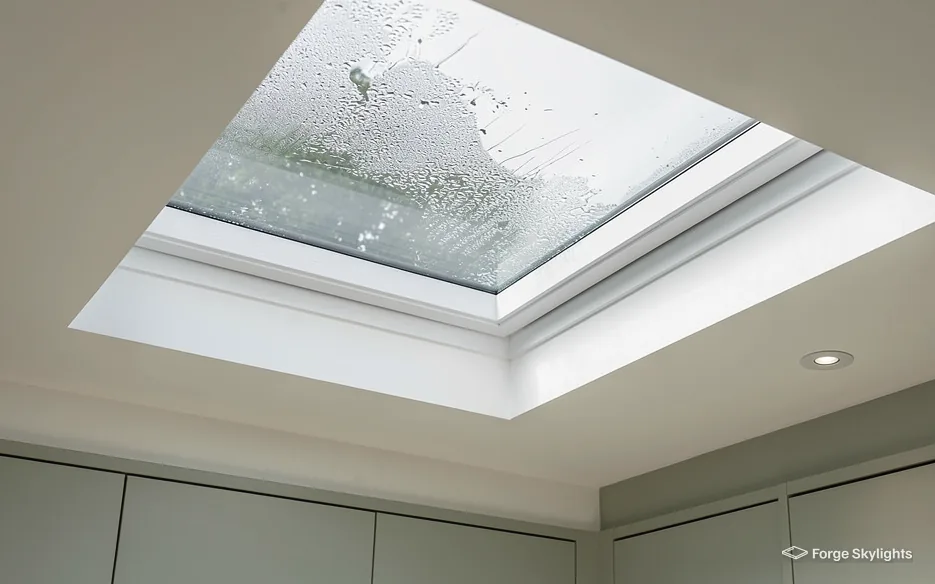
The short answer
Mist between the panes means the sealed edge of the double-glazed unit has failed and damp room air has found its way into the gap. The mist sits inside the glass, so it cannot be wiped off from the room or from the roof, and it usually spreads slowly until the unit is replaced.
What is happening inside the glass
A sealed double-glazed unit is two sheets of glass held apart by a spacer bar, with a sealant running round the edge. The gap between the sheets is filled with dry air or a gas, and the spacer holds a drying agent that soaks up any trace of moisture left from manufacture. While the seal is sound, the gap stays dry and the glass looks clear.
When the sealant cracks, shrinks or lets go of the glass, damp air moves in and out of the gap as the temperature changes. The drying agent in the spacer fills up, and after that the moisture has nowhere to go. It condenses on the cold inner faces of the glass as a cloud, a film of droplets or a line of tide marks, and it often shows first along the lower edge or in one corner.
A rooflight is harder on a seal than a wall window. It faces the sky, so it takes the full heat of the sun on a summer afternoon and the coldest night sky in winter, and water sits on or runs across it for longer than it does on a vertical pane. A skylight that has had many seasons of that will often show mist before the frame itself looks tired.
Mist between the panes or condensation on the glass
Two different problems look similar from the room, and the fix for each is different. A quick test settles which one you have: wipe the glass on the inside with a dry cloth and look again.
| Item | Failed seal | Surface condensation |
|---|---|---|
| Where the mist sits | Between the two sheets of glass | On the room face of the inner pane, or on the outer face |
| Wiping it | Makes no difference from either side | Clears, then returns while the air stays damp |
| When it shows | Any time, often worse after a cold night or a hot day | Cold mornings, after cooking, showering or drying washing |
| What it points to | A sealed unit that needs replacing | Damp air in the room, or a cold edge on the glass or frame |
| What puts it right | A new sealed unit, or a whole new rooflight | Better ventilation, warmer glass or a different edge spacer |
Surface condensation on a sound unit is a ventilation question more than a glazing one, and our answer on rooflight condensation goes through what reduces it. Mist that stays put when you wipe is the case this page is about.
Why seals fail
Age is the usual cause, because sealant hardens and loses grip over many cycles of heating and cooling. A few other things bring it forward.
- Standing water. A rooflight at a shallow pitch, or one with a blocked drain channel, keeps the edge of the unit wet for long stretches, and wet sealant ages faster.
- Heat build-up. Dark frames and south-facing roofs run hot, and the gap pressure rises and falls with every sunny spell, which works at the seal.
- Movement. A frame that has flexed, or a unit that was not packed and supported properly when fitted, puts strain on the edge.
- A manufacturing fault. A unit that mists early in its life may still sit inside the maker's own warranty, so keep any paperwork from the original fitting.
Clean glass and a sound frame can sit around a misted unit, which is why many misted rooflights do not need to come out whole.
Cleaning does not remove it
The mist is inside a closed space, so no cleaning product can reach it. Some firms offer to drill the glass and treat the gap, but a unit that has lost its seal has also lost the insulating performance it was bought for, and a sealed gap cannot be made sound again with the edge left as it is. The lasting answer is a new sealed unit made to the exact size of the old one, or a new rooflight where the frame has aged as well.
Mist does not make a rooflight unsafe in itself. It dims the view and lets more heat pass through the glass, and the unit tends to look worse over time as more of the gap clouds over. Glass that is cracked or loose in its frame is a different matter and is better looked at promptly.
What replacing it involves
There are two routes, and a survey tells you which one fits your roof.
Two ways to put it right
New sealed unit only
- Frame
- Kept
- Cost
- Usually lower
- Best when
- The frame is sound and the right size
Our page on replacing a misted sealed unit sets this job out.
Whole new rooflight
- Frame
- Replaced
- Cost
- Usually higher
- Best when
- The frame is worn, leaking or poorly insulated
Changing frame and glass as one is notifiable work, so our firm sends Building Control its notification as part of the job.
A new unit in an old frame is not notifiable, while a whole new rooflight is. Our guide to replacing a rooflight and the Building Regulations explains the difference, and our hub on misted rooflight replacement brings the whole subject together.
The free survey takes in the frame, the seals, the upstand or kerb and the state of the roof covering round the edge, and we then write up both routes, with makers compared where the roof suits more than one. Book a free survey and the written quote puts the options next to each other.
Related questions
Can misted glass clear up by itself?
The mist can fade on a dry, warm day and come back when the weather changes, since the gap is still open to the air. Once the seal has failed it does not heal.
Is a misted skylight covered by a guarantee?
Possibly, if the unit is still inside the maker's warranty or the installer's guarantee, so find the original paperwork first. The unit keeps whatever warranty its maker gives, and the work we do is under a 10-year workmanship guarantee.
Will the whole frame need replacing?
Frequently the frame turns out to be fine and the sealed glass unit is the only part that has failed. We check the frame, the seals and the surrounding roof covering at the survey before suggesting either route.
Does mist mean water is coming through the roof?
Mist in the gap is moisture from the room air, not rain getting in. Damp marks on the plaster round the frame are a separate sign, and they are worth mentioning at the survey.