Why old domes give up
Polycarbonate dome rooflights went onto a great many Birmingham flat roofs: garages, kitchen extensions, porches, lean-to additions and the back of terraced houses. They were cheap to make, light to carry and easy to fit, and for years they did their job. Then the plastic began to age. If your dome has gone the colour of weak tea, picked up a web of fine cracks or lost its shine, it is behaving as polycarbonate does after long exposure to sunlight.
The yellowing is a change in the plastic itself, which an outer coating slows but cannot stop. The fine cracking, called crazing, follows. Many older domes are a double skin, two moulded sheets with an air gap between them, and when the seal round the edge of that pair gives out, dirt and damp gather inside, in much the way a sealed glass unit mists. Our page on why a rooflight mists between the panes explains the glass version of that failure.
A dome that has reached this stage lets in a dimmer, yellower light than it did when new, and is less able to hold heat in. It may also have become brittle. That matters if anyone has to walk near it, and it is a reason not to lean on it for a ladder or a quick look from the roof.
Before replacing anything, we need to know what sits underneath. The dome is only the visible part. What it stands on, the kerb or upstand, decides almost every choice that follows, and the next chapter explains why.
The kerb decides what comes next
A dome sits on a kerb: a raised frame around the opening that lifts it above the roof surface and gives the covering something to turn up against. On older flat roofs the kerb is often a thin plastic or fibreglass moulding, sometimes a rough timber box, and sometimes little more than a low lip. They vary a great deal in height, in condition and in how well the roof covering has been dressed up them.
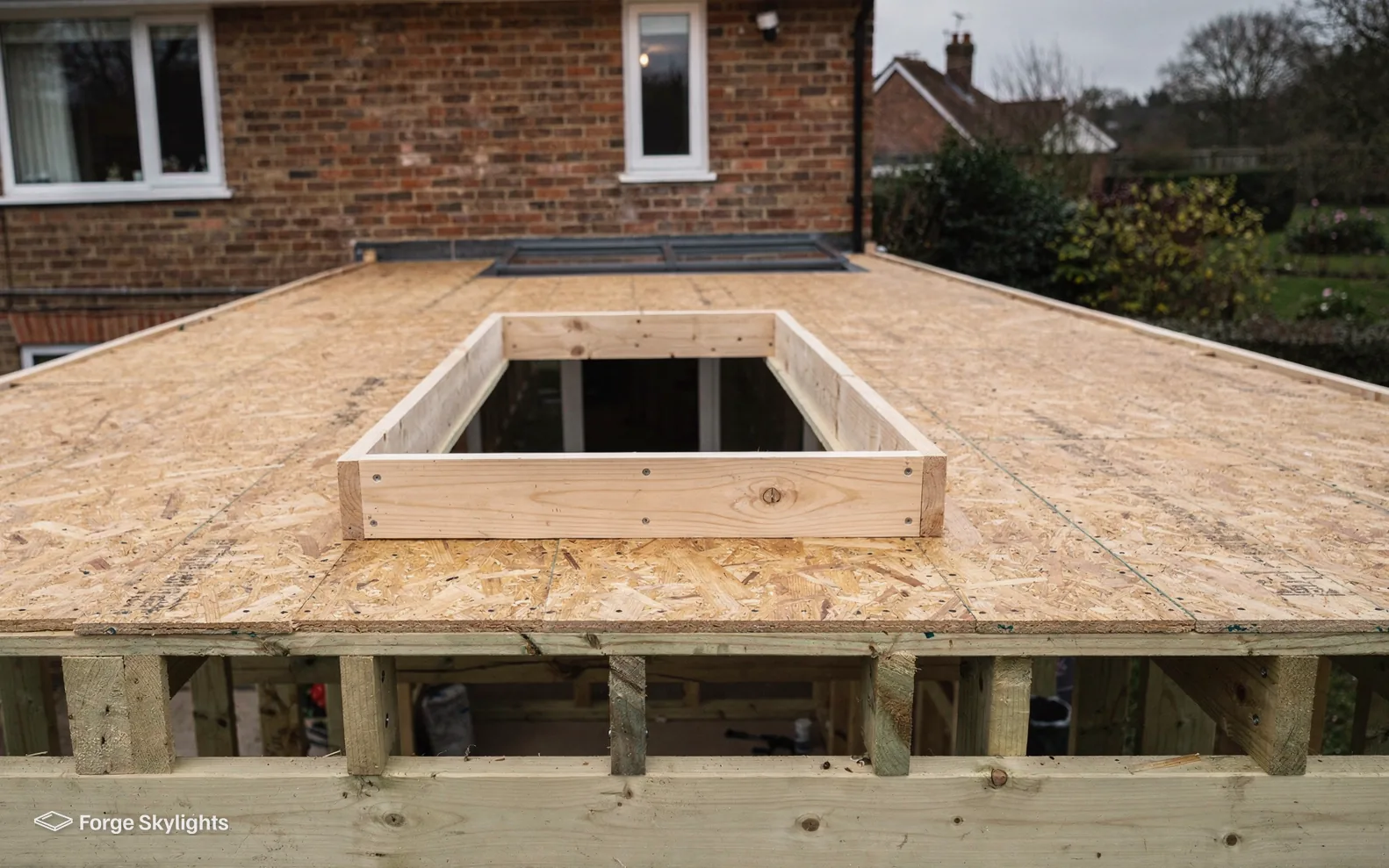
When we survey a dome, we look at the kerb before the dome. We want to know whether it is sound and square, whether it is tall enough for the roof covering to be turned up it properly, whether it is insulated, and whether there is any sign that water has been getting into the timber or the deck round it. A kerb that passes all of those can often take a new rooflight directly. One that does not has to be rebuilt or replaced first.
Domes are frequently fitted to kerbs that do not meet the standard we would build to today. Low kerbs are particularly common, and so are uninsulated ones, which leave a cold spot round the opening where condensation collects. Replacing a dome on a poor kerb with a fine new glass rooflight is a little like putting a new window into a rotten sill. The window is not the problem, but it will not last long.
The old opening also tells us about the roof itself. If the covering round the dome is cracked or lifting, or if the deck is soft, the work widens from a rooflight swap to a conversation about the roof, and we say so in writing before anything is ordered. Our page on flat roof rooflights covers the options when a flat roof and its rooflights are being thought about together.
Like for like, or something better
You have two broad ways to go. You can fit a new polycarbonate dome in the same place, or you can move to a flat glass rooflight on the same opening. Both are straightforward when the kerb is right, and each has things in its favour.
Dome or glass, on the same measures
New polycarbonate dome
- Look
- Raised bubble, modest
- Light
- Bright, slightly diffused
- Insulation
- Fair; better when double skinned
- Cost
- Usually lower
- Feel in the room
- Functional
A sensible choice for a garage, store or utility room where cost matters most.
Flat glass rooflight
- Look
- Flat or low ridge, crisp
- Light
- Clear and neutral
- Insulation
- Better, with modern coatings
- Cost
- Usually higher
- Feel in the room
- A feature
A good choice for a kitchen, dining room or any space you sit in.
Neither is wrong. A dome is quick and economical, and a new one has none of the stains of the old. Glass costs more but lasts longer in appearance, stays clear, and generally performs better as insulation, which you notice in a kitchen on a cold morning and a bright afternoon alike.
If you are not sure which suits the room, ask us to price both. Every written quote sets more than one option side by side, with a size, a specification, a lead time and a price, so you can compare them on one page. The glass options, and what separates them, are laid out in our guide to energy efficient rooflights.
Sizes, and how the opening is matched
Domes were made in a modest range of stock sizes, often round-number openings in centimetres or inches, which is why so many are an awkward fit for modern rooflights. A modern flat glass rooflight comes in its own set of standard sizes, with a made-to-measure route for the ones that do not match.
Our usual approach is to measure the existing kerb on the outside and the inside. If its outer size is close to a stock rooflight, we may be able to choose that size and fit the new rooflight onto the existing kerb, if the kerb is sound. If it is not close, we compare three choices. A made-to-measure rooflight built to the old kerb is one. Adjusting the kerb to suit a stock rooflight is another. Making the opening a better size for the room is the third, which is worth considering if the room has changed since the dome was fitted.
Bigger openings need the joists examined. Taking out part of a joist to make a larger opening means carrying its load on trimmers, and that has to be designed properly. A smaller or equal opening is much simpler, since the structure is already there. Our guide to how roof lantern sizes are worked out explains the same logic in more detail, and it applies to flat rooflights as well.
A word on making the opening bigger
A larger rooflight on the same roof can change the planning position as well as the structure. Our rooflight planning guide sets out those conditions, and we look into your address's position at the survey. The council decides.
How the flat roof is made good
The roof covering round a dome has usually been dressed up the kerb in felt, a liquid coating or a single-ply membrane, and the work of replacing the dome disturbs it. The new rooflight cannot simply be lowered on and left. The covering has to be made continuous with the new upstand, and the junction is the part of the job that keeps water out for years.
What that involves depends on the roof. A felt roof near the end of its life may be best renewed round the whole opening. A single-ply membrane may be welded to the new kerb. A liquid-applied roof can be taken up the upstand and finished in the same system. If the roof was laid by another firm, we match their system where we can, or we explain what has to change and why.
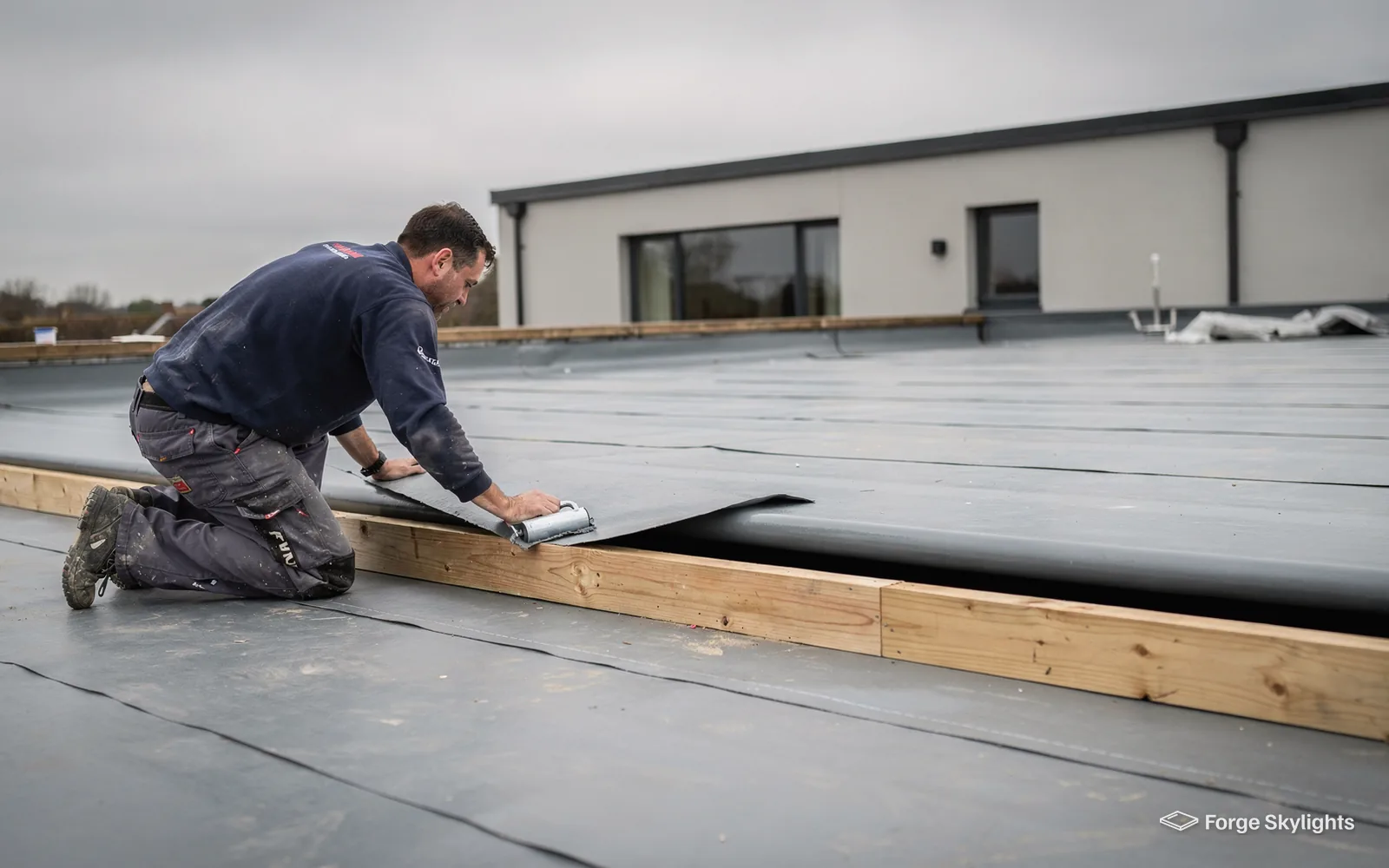
Insulation matters here too. A new kerb should be insulated so that the glass does not sit on a chilled upstand that grows damp. If the roof has insulation laid on top of the deck, the kerb height must suit the build-up so the covering turns up far enough. We check the existing build-up at the survey, which often means looking from inside the loft space or from below, and mention anything that will change the order of work.
A good replacement ends with a finished junction you do not have to think about again, a lining inside that suits the new rooflight, and a roof that is dry and tidy around it. Where the lining inside is damaged or stained from the old dome, we include its making good in the quote.
Regulations and what we handle
Replacing a whole dome rooflight, frame and glazing, counts as the replacement of a controlled fitting, which makes it notifiable under the Building Regulations. Sending the notification to Building Control is our job, and the new rooflight is specified to meet current limits. Table 4.2 of Part L 2021 caps rooflights fitted to existing homes at 2.2 W/m²K, and the quote gives the maker's own figure for every rooflight we offer.
That requirement applies whether you choose glass or a new polycarbonate unit. A modern dome must also meet the limit, and it is one reason to compare the two honestly on the same quote rather than assuming the cheaper choice is a straight swap. Our page on whether replacing a rooflight needs Building Regulations approval covers the detail.
If an existing dome has only a failed seal and no other fault, a different job may be possible for a glass rooflight: renewing the sealed unit alone. That is not notifiable. It does not apply to a single or double skin polycarbonate dome, because those are not sealed glass units. We cover that distinction in our guide to replacing the sealed unit or the whole rooflight.
One more point on safety. Domes are not meant to be walked on, and neither are most glass rooflights. If the roof will be used for access, for a flat roof terrace or for maintenance, say so at the survey. A walk-on option exists, and our page on walk-on rooflights explains where it makes sense.
Putting it in order
A dome replacement follows a clear sequence, and knowing it in advance makes the quote easier to read.
Survey the dome and kerb
Size, height, condition and construction of the upstand, and the state of the roof covering around it.
Choose the direction
A new dome or a glass rooflight, with the room and the budget in mind.
Match the size
Stock or made to measure, with the kerb adjusted or rebuilt where the old one will not do.
Read the written quote
Each option side by side: glass or polycarbonate, frame, opening, lead time and price.
Fit and make good
Old dome out, kerb dealt with, new rooflight in, covering turned up and finished, lining made good inside.
Notify and guarantee
The Building Control notification is made, and you get our guarantee on the workmanship plus the warranty from the maker.
Our work carries a 10-year workmanship guarantee. Book a free survey and we will look at the dome and the kerb, say plainly what the roof will take, and put the options in writing.
Common questions
Can I put glass on my existing dome kerb?
Often, provided the kerb is in good order, square and high enough for the roof covering to be dressed up against it. We check this at the survey, and rebuild or raise the kerb where it will not do.
Why has my dome turned yellow?
Polycarbonate ages in sunlight, and the yellowing is a change in the plastic itself. It cannot be polished out, and fine cracking usually follows.
Is a new polycarbonate dome a poor choice?
It suits garages, stores and utility rooms where cost comes first. Glass costs more and gives clearer light and better insulation, so we price both for rooms you spend time in.
Will replacing the dome mean redoing the roof?
Only the covering round the opening is usually affected. If the wider roof is also tired, we say so in writing, with the cost of dealing with it and the cost of leaving it.
Does a dome swap need Building Regulations notification?
A whole-rooflight swap is notifiable, and sending the notification falls to us. The new rooflight is also specified to current energy limits.
Can I choose a bigger rooflight than the dome?
Often, if the joists and the roof allow it. Planning may look at a larger opening differently, so your address is checked by us and the council decides.