
Start with the room, not the roof
Most questions about lantern size begin on the roof: how big an opening will the joists allow, and how much glass can we fit? Those questions matter, but they come second. A lantern is something you live under, so the first measurements we take are inside. How long and wide is the room? How high is the ceiling? Where will the island, the table or the sofa go? Which way do the doors to the garden face?
A lantern that suits the room sits over the part of it you use most and leaves a sensible margin of plain ceiling around it. Over a kitchen island it gives the worktop a pool of daylight. Over a dining table it makes the table the centre of the room. Over a long open-plan space it may make sense to light the middle and let the doors at the end light the rest.
Size also changes how a room feels. A generous lantern in a compact extension can make it feel taller and brighter, but there is a point where the ceiling becomes mostly glass and the room starts to feel like a conservatory, warm in summer and harder to furnish. A lantern that is too small over a long room leaves the ends noticeably darker than the middle. We sketch the options on your plan so you can see the margins before anything is ordered.
It helps to think about the room at different times of day. A lantern over a kitchen that faces the garden at the back of a terrace will light the worktops in the morning and the table in the evening differently, and a room used mostly after work may want light where the sofa is rather than where the sink is. Tell us how you use the space and we will size and place the lantern for that.
We draw each lantern size on your floor plan, with its margins, before anything is ordered.
What the flat roof allows
Once we know roughly where the lantern should go, we look at the roof. On a flat roof the joists usually run front to back or side to side across the extension, and their direction and spacing set the easiest positions for an opening.
An opening that falls between existing joists needs the least structural work. A wider opening means cutting one or more joists and carrying their load on trimmers either side, which is normal practice but needs to be sized properly for the span. On a lantern of any real size we ask for the structural detail before ordering, so the opening and the lantern are designed together.
We also check the roof deck and the covering. A sound, dry deck can take a new opening; a soft deck, or a covering near the end of its life, changes the plan. If the roof is due for a new covering anyway, that is the best time to fit a lantern of the size you really want, since the covering, the kerb and the opening can all be dealt with in one go. Our answer on fitting a roof lantern to an existing flat roof covers that case in more detail.
Parapets and boundaries
Where an extension sits on or near a boundary, or behind a parapet wall, the lantern's position and height may also need checking against the planning rules. The conditions for rooflights are set out in our rooflight planning guide, and the survey is when your address is examined for its position.
The kerb sets the order size
A lantern does not sit straight on the roof. It sits on a kerb, sometimes called an upstand: a raised timber frame built around the opening, which lifts the glass clear of the roof surface and gives the roof covering something to turn up against and seal.
A lantern is ordered to the kerb, and makers state whether their sizes refer to the outside or the inside of the kerb. If the kerb is built to the wrong dimension, the lantern will not sit square on it, however good the lantern is. We confirm the sizing convention with each maker before quoting, write the kerb size on the quote, and agree it in writing with your builder if they are building the kerb.
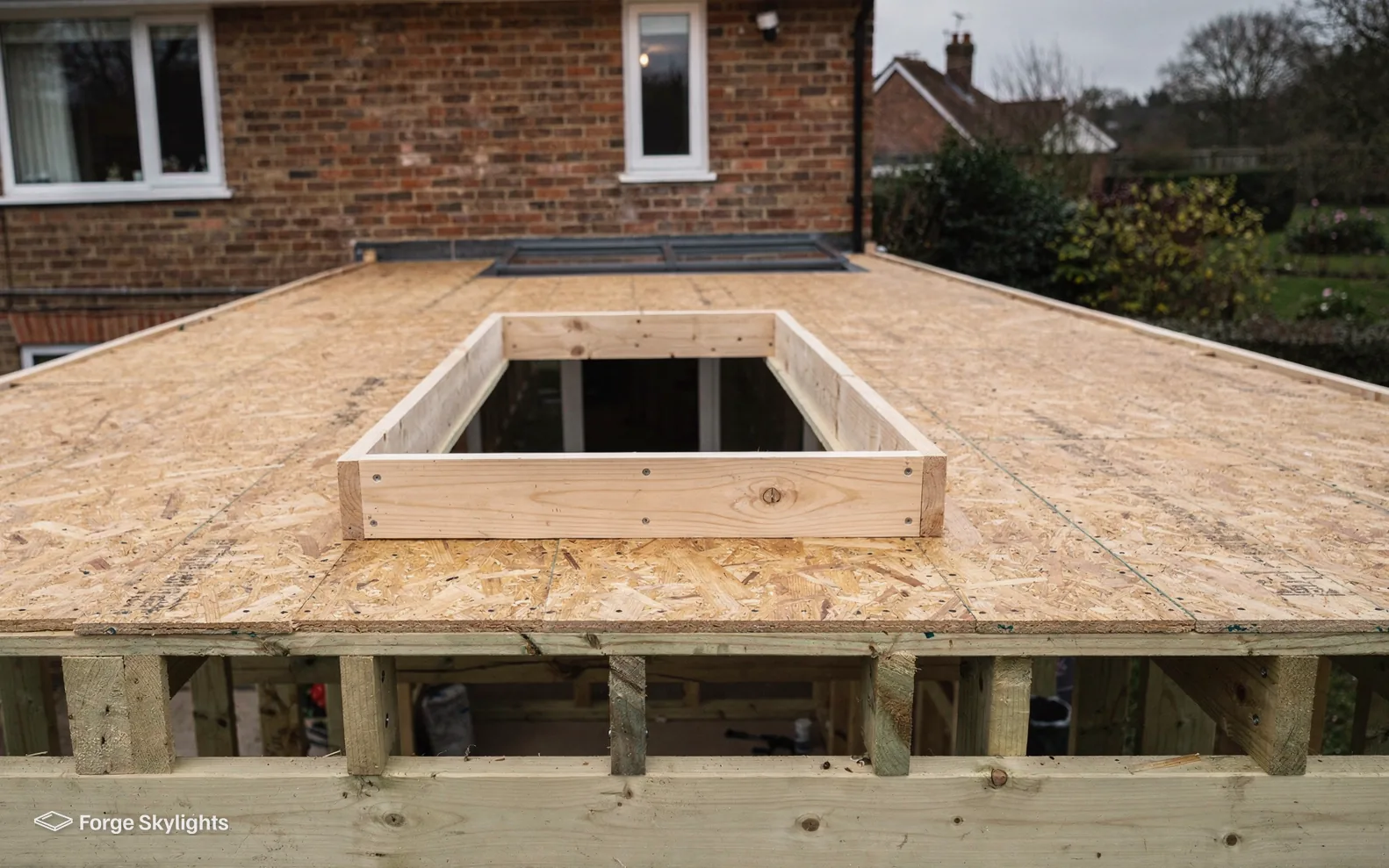
The kerb's height matters too. A taller kerb gives a deeper lined box between the ceiling and the glass, which changes how the light spreads into the room and how the lantern looks from inside. The height also has to suit the roof build-up, including any insulation laid on top of the deck, so that the covering can be dressed up the kerb properly.
- Outside size: what the lantern is ordered to, by the maker's convention.
- Height: set by the roof build-up and the finish you want inside.
- Square and level: checked before the lantern arrives, because the frame relies on it.
Stock sizes or made to measure
Lanterns come in two broad kinds. Stock lanterns are made in a range of standard sizes. Made-to-measure lanterns are built to the dimensions of your kerb. Both can be excellent; the difference is in price, lead time and how well the size fits your room and roof.
| Item | Stock size | Made to measure |
|---|---|---|
| Size | Chosen from the maker's range | Built to your kerb |
| Fit to the room | Close, if a size suits | Exact |
| Lead time | Often shorter | Often longer |
| Price | Usually lower | Usually higher |
| Best for | New openings sized to suit | Finished roofs and awkward plans |
If your extension is still being designed, it is often possible to size the opening and the kerb to a stock lantern and save money without losing anything you care about. If the extension is already built, the joists may set the limits, and a made-to-measure lantern can use the space properly instead of leaving an awkward margin.
Shape plays a part as well. A rectangular hipped lantern, traditional or slimline, is made in the widest range of sizes. A pyramid lantern needs a square or nearly square opening. Our hub page on roof lantern installation compares the shapes side by side.
Glass, weight and the frame
As a lantern gets bigger, its glass panels get bigger and heavier. That has knock-on effects. Larger panels need stronger bars, which can make a slimline frame less slim. Triple glazing adds weight again. Some makers set maximum sizes for each frame and glass combination, so the biggest lanterns may only be available in certain specifications.
This is one reason the frame choice and the size choice are made together. Aluminium carries large panels on slimmer bars than uPVC, which is why bigger lanterns are usually aluminium. Our guide to aluminium and uPVC roof lanterns lays the two out side by side.
Bigger glass also means more summer heat. A large lantern over a south or west facing room may need a solar control coating to stay comfortable on a bright afternoon. Coated and uncoated versions are both priced, one beside the other, which shows you exactly what the coating adds for the money. Thermally, new glazing in an existing home must meet Part L 2021, which gives rooflights 2.2 W/m²K, and every unit on our quotes shows the maker's figure.
Sizing a replacement lantern
Replacing an old lantern is a different sizing job. The opening and the kerb already exist, so the first question is whether to keep them. Older lanterns, often timber or early uPVC with polycarbonate sheets, were sometimes fitted to kerbs that are low, uninsulated or out of square, and a new glass lantern may need more from its kerb than the old one did.
If the kerb is sound, square and tall enough for the roof covering to turn up it properly, we can order a new lantern to fit it, usually made to measure because old openings rarely match today's stock sizes. If it is not, we rebuild or raise the kerb, and that is the moment to ask whether the opening is still the right size for the room as it is used now. A kitchen that was once a separate dining room may suit a larger or differently placed lantern.
Exchanging an entire lantern, glass and frame, is a notifiable job under the Building Regulations, with the Building Control notification coming from us. If only the sealed glass units have misted and the frame is sound, reglazing may be enough, which is not notifiable. How we tell the two apart is set out on our misted and failed rooflight replacement page.
Measure twice
On a replacement we measure the kerb with the old lantern off, not on, because the old frame can hide a kerb that is out of square or damaged by water. Any surprise is priced before the new lantern is ordered.
From measurements to an order
Here is the order we work in when sizing a lantern for a Birmingham extension:
Measure the room
Floor plan, ceiling height, where the furniture and doors are.
Map the joists
Their direction and spacing, and where an opening can go without more trimming than it needs.
Check the roof
The deck, the covering, the fall and any parapet or boundary.
Propose sizes
One or two sizes that suit the room, drawn on your plan with the margins shown.
Match to makers
Each size checked against stock ranges, with made-to-measure priced where no stock size fits well.
Confirm on site
Once you choose, the kerb is measured again before the lantern is ordered.
Your written quote then sets the options side by side: each lantern's size, shape, frame, glass, lead time and price, plus the kerb and roof work around it. If you would like to see how the sizes affect the price, our answer on how much a roof lantern costs to fit explains each part of the figure.
To get sizes worked out for your own extension, book a free survey and we will measure up inside the room and out on the roof, then lay out the sizes that suit them next to each other.
Common questions
Is a lantern measured to the inside or the outside of the kerb?
It depends on the maker, and each one states it. We check the convention for every lantern we quote and write the kerb size on the quote, so the lantern and the kerb match.
Can I have a bigger lantern than my builder drew?
Often, if the joists and the roof allow it and the size still suits the room. Both are checked at the survey, and the options are shown to you on your plan.
Does a bigger lantern need planning permission?
Size alone does not decide it. Many lanterns fall under permitted development if they meet the conditions in our rooflight planning guide. Your address gets its position looked at by us.
How close to the edge of the roof can a lantern go?
That depends on the joists, the roof's edge detail and any parapet, and on the planning position for your address. We look at all three at the survey and show the lantern's position on your plan before you decide.
Are made-to-measure lanterns worth the extra?
They are when the room or the roof does not suit a stock size. Where a stock size fits well, it usually costs less and may arrive sooner, and both routes appear side by side on the quote, ready for you to compare.