The short answer
A roof lantern on a house is often covered by permitted development, but only within the conditions of Class C of the General Permitted Development Order, and a lantern is taller than a flat rooflight, so those conditions need a careful look. The conditions and the planning history attached to your address are checked by us, and the final decision sits with the council.
Why a lantern is treated differently from a flat rooflight
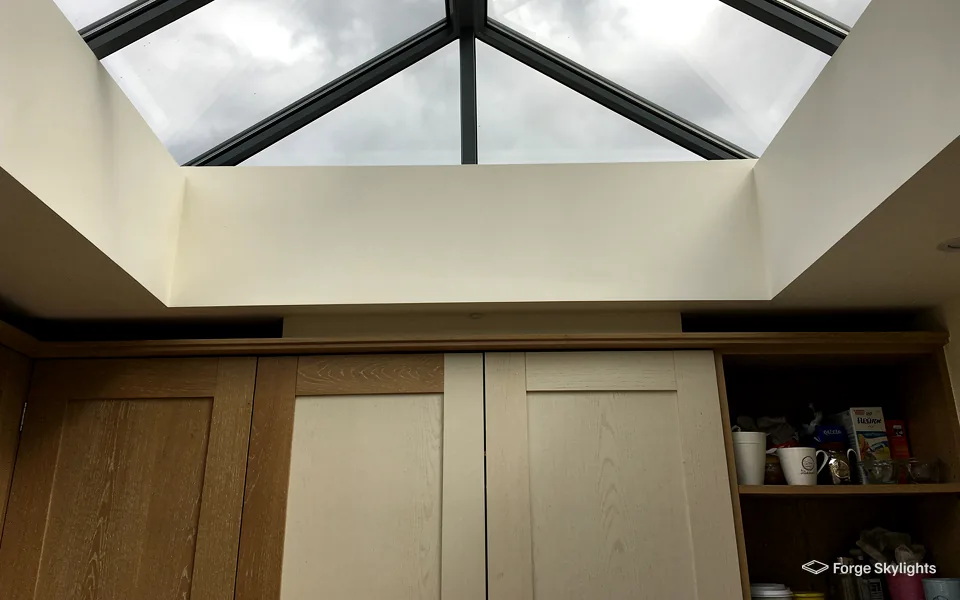
A flat rooflight lies almost level with the roof. A roof lantern is a glazed box that stands up from a kerb, with sloping glass on all sides and a ridge or a point at the top. That extra height is what planning rules are interested in, because it changes how the roof looks from the garden, from the street and from your neighbours' windows.
Permitted development is the national set of rules that lets some building work go ahead without a planning application. The General Permitted Development Order deals with rooflights in Schedule 2, Part 1, under Class C. The conditions attached to Class C are set out in full in our rooflight planning guide, and they live on that one page so that you always read a single up to date version.
What we can say here is where a lantern is likely to be tested against those conditions. Its height above the roof surface, the way it sits on the kerb and the glass it uses are the three details a council officer looks at first.
Lantern or flat rooflight, side by side on planning
Both products can sit inside permitted development on a house when the conditions are met. They differ in how much room they leave for error.
| Item | Roof lantern | Flat rooflight |
|---|---|---|
| Height above the roof | Stands up from a kerb, so the height needs checking against the guide | Sits low, so it is easier to keep within the conditions |
| Look from outside | Clearly visible as a feature of the extension | Barely visible from the ground |
| Neighbours and street | Raises more questions if the roof can be seen from the road | Seldom raises any |
| Where we look first | Total height of the lantern and its kerb | Projection of the frame |
| If the answer is no | A lower lantern or a flat rooflight may fit | A different position on the roof may fit |
If the measurements make a lantern awkward, our answer on a roof lantern or a flat rooflight compares the two on light, height and look, so you can see what you give up by going lower.
Where permitted development is not the whole answer
At some addresses permitted development is not the whole answer, and it is worth finding out before a lantern is ordered.
- Listed buildings. Whatever permitted development would allow, a lantern fitted to a listed property requires listed building consent. Our guide to listed building rooflight consent covers that route.
- Article 4 directions. A council can remove permitted development rights for an area or a street. We check the council's record for your address on every quote.
- Planning conditions. A permission for the house or the extension can carry a condition that takes the rights away. The decision notice for the extension is the document to look at.
- Flats and maisonettes. The rights that apply to houses do not cover flats in the same way, so a flat roof over a maisonette needs its own check.
Conservation areas bring their own questions about how a roof looks from public places, and our page on rooflights in conservation areas explains what to expect.
The extension itself comes first
A lantern is usually part of an extension, and the extension has its own planning position. If the extension was built under permitted development, or under a permission with conditions, the lantern is looked at in that context. A lantern added to an old extension is a separate question from one designed with a new build.
If you are building the extension now, the best time to settle the lantern is before the roof drawings are final. The kerb height, the lantern height and the ceiling height inside all depend on each other, and a lantern drawn into the plans at the start is easier to approve than one added later. We can give your architect the lantern details in writing, and the maker's drawings show the size and height of each option.
What we check, and what the council decides
During the free survey we study the roof, the extension and your address, then test the conditions against each lantern option on your quote. Where a lantern looks marginal we say so and show a lower alternative beside it. Where you want certainty, you can ask the council to confirm the position in writing, which is a separate application that we can explain.
- Address checked for listing, Article 4 and conditions
- Lantern height and kerb measured against the guide
- A lower option priced beside it where the height is marginal
The council has the final word on planning, and we say so on every quote. Where building work is involved, the Building Regulations apply to any fresh opening cut in the roof, and notifiable jobs have their Building Control notification sent by us. Cost questions follow naturally, and our answer on what a roof lantern costs sets out what moves the price. To have your roof, your address and the suitable lanterns looked at together in one visit, book a free survey with us.
Related questions
Do I need to apply to the council before ordering a lantern?
Not always. Where the work falls within permitted development, no application is needed, but the address has to be checked first. We do that at the survey, and you can ask the council for written confirmation if you want it.
Will a lantern on a new extension be treated as part of the extension?
If it is drawn into the extension plans, it is considered with them. A lantern added later is looked at as a change to a finished roof, which is why settling it early helps.
Is a lantern harder to get approved than a flat rooflight?
Its extra height gives the council more to measure, so it needs more care. Our flat roof rooflights sit lower and are easier to keep within the conditions.
Does living in the Green Belt change the answer?
Green Belt does not change the permitted development rules for rooflights. Listing, Article 4 directions and planning conditions are what can.