The short answer
Choose a roof lantern if you want the extension to have a visible feature with light coming in from several sides, and a flat rooflight if you want the cleanest ceiling and the lowest profile. The lantern usually costs more and stands taller; the flat rooflight sits almost level with the roof and is simpler to clean.
Light: sides against a single plane
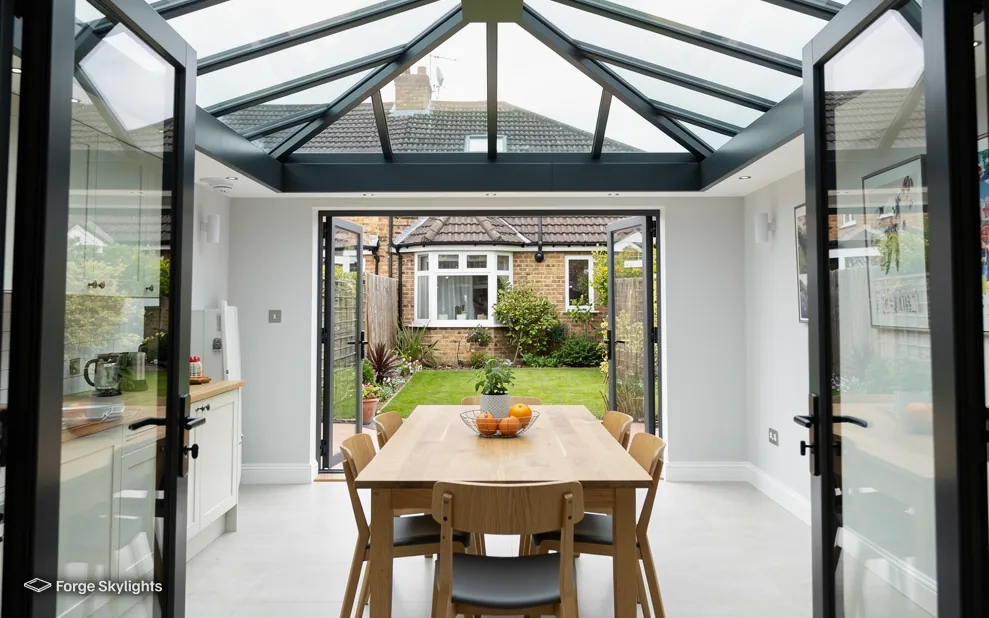
A lantern has glazed sides as well as a glazed top, so it takes in light as the sun moves round and sends it down into the room at several angles. In a kitchen with a long dining table, that spreads brightness more evenly than a single pane does.
A flat rooflight is one sheet of glass in a frame. It gives the most direct light when the sun is high, and its simple shape means the whole opening is clear glass. A large frameless one can flood a small room, and a pair set apart can light two zones. Our page on frameless flat rooflights shows how thin the frames can be.
The size of the opening matters more than the type. A large flat rooflight can let in more daylight than a small lantern, so the two are best compared at the size your roof allows.
Side by side on the measures that decide it
Roof lantern and flat rooflight on the same rows
Roof lantern
- Light
- From the top and the sides
- Height
- Stands up from the kerb
- View from the garden
- A clear feature of the extension
- Cleaning
- More glass faces to reach
- Price
- Usually higher
Best where the extension should have a focal point.
Flat rooflight
- Light
- Strong from above
- Height
- Sits close to the roof
- View from the garden
- Barely seen from the ground
- Cleaning
- One surface to wipe
- Price
- Usually lower
Best where a low profile and a clean ceiling matter.
The price gap follows the construction. A lantern has more frame, more glass panels and a taller kerb, while a flat rooflight has a single glazed unit and a lower upstand. Our roof lantern cost answer and our flat roof rooflight cost answer each set out what moves the price.
Height, planning and the look from outside
A lantern is seen from the garden, from upstairs windows and sometimes from the road. That suits a deliberate design, and it can look top heavy on a low or small extension. A flat rooflight is nearly invisible from the ground, which suits a house where the extension should stay quiet.
Height also shapes the planning position. A taller lantern gives the council more to measure than a low flat rooflight does, and both products sit under Class C of the General Permitted Development Order, subject to the conditions in our rooflight planning guide. Checking your address falls to us, while the final say belongs to the council.
Heat, glare and keeping it clean
Glass facing the sun can overheat a room, whatever the shape. Both products take solar control glass, and on a south or west facing extension it is worth pricing. A lantern with side glass facing the afternoon sun can warm up faster than a flat rooflight of a similar area, so the glass choice carries more weight there.
Cleaning is the practical difference people forget. A flat rooflight can usually be reached with a long handled brush or a cloth from a ladder, and rain rinses most of it. A lantern has several faces and bars, and leaves and dirt gather on the lower ledges. A self-cleaning coating helps both. If the roof is hard to reach, say so at the survey and we will bear it in mind when we compare options.
Each product can be fixed or opening. A lantern with an opening vent can release warm air from high in the room, and a flat rooflight can be made to open too. See our flat roof rooflights page for how the opening types differ.
How we help you decide
The free survey is where we measure the roof, the opening and the room below, and lanterns and flat rooflights are then priced next to each other, with several makers priced when the roof permits. Each option on the quote lists its own price, lead time, opening, frame and glass in that order, so the choice is made on identical measures.
- Both products priced for your opening
- Glass options compared for heat and glare
- Maker lead times listed on the quote
Some homeowners find that a flat rooflight gives the light they wanted at a lower price, and others find the lantern changes the whole room. If you are unsure, book a free survey and we will bring both.
Related questions
Can a lantern and a flat rooflight go on the same extension?
They can. A lantern over the dining area and a flat rooflight over a worktop or a corridor is a common pairing, because each does the job it suits.
Which gives more light for the price?
A flat rooflight often gives more glass area for the money, because it has less frame and a lower kerb. A lantern gives the more varied light, and the quote prices both at your opening size.
Is a lantern harder to keep warm?
It has more glazed edges, so the glass specification matters. Part L 2021 sets the limits for rooflights in existing dwellings, and we fit to them whichever product you choose.
Does a flat rooflight need a lantern style kerb?
It needs an upstand, usually lower than a lantern kerb. See our page on flat rooflight upstands for how it is built.