
Five types, one question: which suits your roof?
The type of skylight you can fit is decided first by the roof, then by the room, and only then by taste. A pitched tiled roof takes a roof window or a conservation rooflight. A flat roof takes a flat rooflight or a roof lantern. A dark hallway with no outside wall takes a sun tunnel. Knowing which of those three situations you are in cuts the list from five to two before you compare anything.
Trade and homeowner words overlap here, which causes some confusion. "Rooflight" is the word architects, builders and makers use for almost every glazed unit in a roof. "Skylight" is the word homeowners usually search for, and it means the same thing. A roof window is a rooflight that opens and sits in a pitched slope. A roof lantern is a rooflight that rises above a flat roof in the shape of a small glazed room. We use both words on this site and mean the same product either way.
The sections below take each type in turn, then set all five side by side on light, opening, glass, fitting and price. Each type has its own page with more detail, and each page links back here. Every written quote we give sets more than one suitable option side by side, from more than one maker where the roof allows, so the comparison you read here is the same one you would see on paper.
Roof lanterns
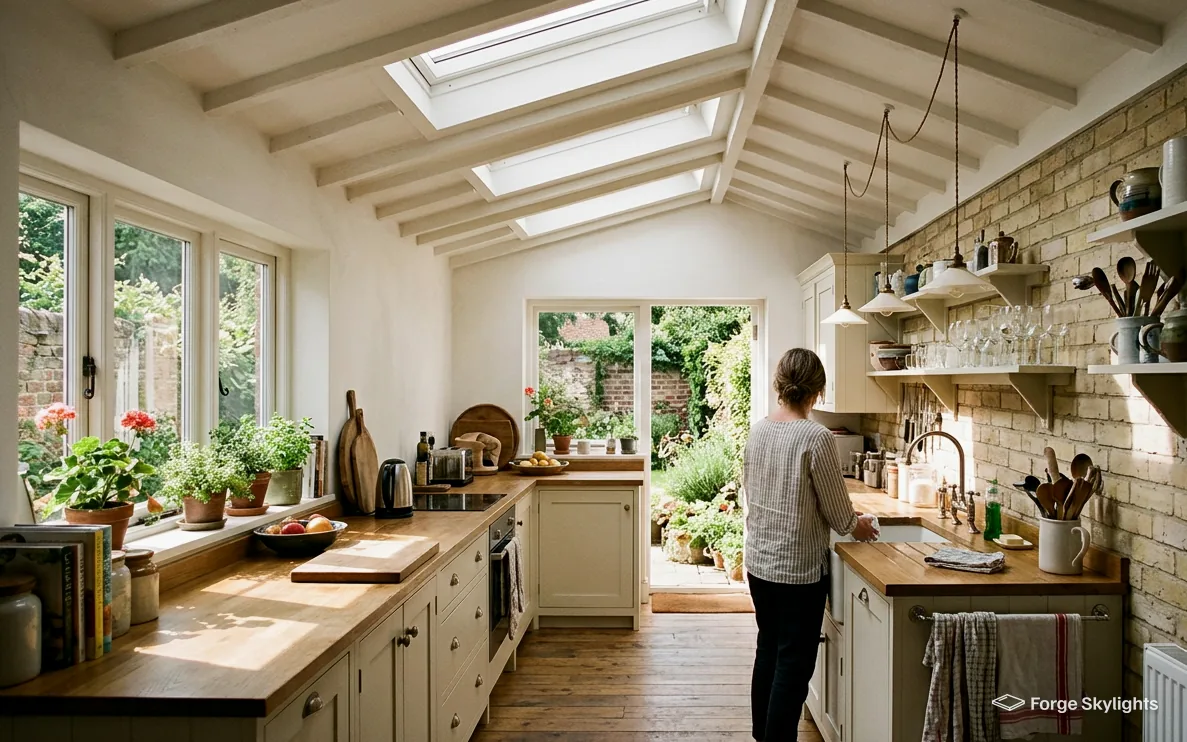
A roof lantern is a glazed structure that stands up from a flat roof, usually with a pitched or hipped glass top, a frame along the sides and a kerb underneath. It brings light into a room from several directions, and from inside it reads as a feature as much as a window. That is why lanterns are common over kitchen and dining extensions, where the ceiling has height to show them off.
Light is the strength. The glass faces up and out, so the room gets sun through more of the day than a flat pane does. Opening is the weak point: most lanterns are fixed, and where fresh air is wanted, vents or an opening panel are added to the design. The frame is aluminium or timber, with uPVC in some ranges, and glass choices run from standard double glazing to solar control and self-cleaning coatings.
Fitting is bigger work than any other type. The lantern needs a kerb built to its size, the flat roof dressed up to it, and the structure checked for the weight. Lead times are often longer than for other types, because many lanterns are made to measure. If you want the detail, our roof lanterns hub has the full set, and roof lantern or flat rooflight is the page for readers choosing between the two.
Lantern or flat rooflight?
A lantern gives more architecture and more light angles. A flat rooflight gives a cleaner, lower roof line and usually costs less. If the ceiling below is low, the lantern's height has less room to be seen from inside, and the flat unit often looks better.
Flat rooflights
A flat rooflight is a pane or a pair of panes set low into a flat roof, with a slim kerb or upstand beneath. Some are framed, some are frameless with the glass bonded to a thin upstand, and some have a slight dome or a ridge. They suit extensions, garages, flat-roofed kitchens and single-storey rear additions.
On light they sit between a lantern and a roof window: a big flat unit passes a lot of daylight straight down, though it does not spread it sideways the way a lantern does. Many open, by hand or by motor, which makes them popular where an extension needs ventilation in summer. Glass is usually toughened or laminated on the inner pane, and the outer pane can carry solar control or a self-cleaning finish.
Fitting is simpler than a lantern. Upstand or kerb, trimmed opening, new roof covering dressed into the unit, and a check that the roof falls away from the glass. A flat rooflight needs the water on the flat roof to run off, and our guide to the upstand heights on a flat rooflight explains why. Prices usually sit below a lantern of similar footprint, depending on frame and glass. Our flat roof rooflights hub collects the full list of pages.
Roof windows
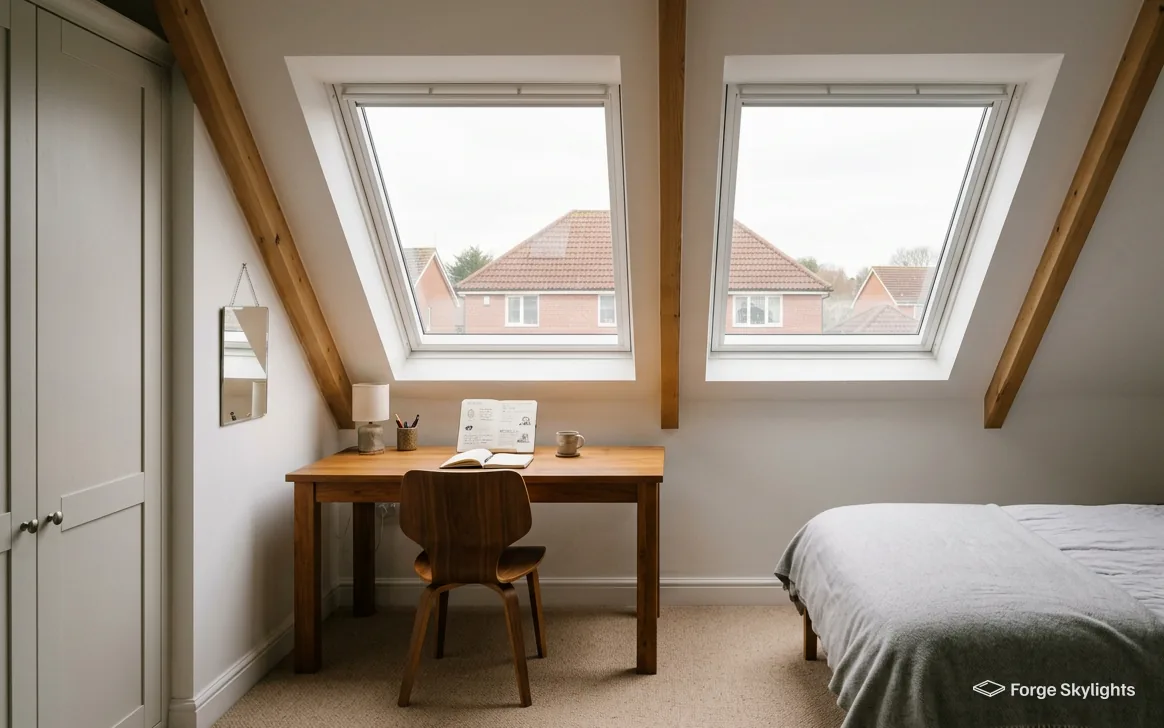
A roof window is a glazed unit in a pitched roof, set into the rafters flush with the tiles and framed in timber, painted timber, polyurethane-coated timber or uPVC, depending on the range. It is the unit you see in loft rooms, converted attics and bungalow roofs, and the product the word "skylight" calls to mind for most people.
Light is good and well directed: a window in a slope sees a wide area of sky and, in a loft bedroom, it can be placed to give a view out as well as light in. Opening is the headline feature. Top-hung and centre-pivot designs open differently, and the pages on top-hung against centre-pivot windows and roof window makes compared set them out. Glazing is double or triple, with laminated inner panes common in the range.
Fitting needs the rafters trimmed, a flashing kit dressed into the tiles, and a plan for the plasterboard splay inside. Fitting in a new opening is the biggest job; replacing a like-for-like unit is quicker. In the roof of a bungalow the window may also serve as the escape route, while a loft conversion on a two-storey house needs a protected stair instead, which is why roof window fire escape is worth a read. The roof windows hub and VELUX windows hub hold the rest.
Conservation rooflights and sun tunnels
A conservation rooflight is a slim, flush-fitting rooflight built to sit in a period roof and look like the cast-iron lights that were once common on Victorian and Edwardian houses. It has a thin frame, often a central glazing bar, and a low profile that sits close to the slates or tiles. It is often chosen in conservation areas and on listed buildings, where the council looks closely at how the roof reads from the street. The conservation rooflights hub covers the range, and conservation rooflight against roof window is the page for readers weighing the two.
A sun tunnel is a small dome on the roof joined to a reflective tube that runs down to a diffuser in the ceiling. It brings daylight to places a normal window cannot reach, such as a hallway, a landing, a bathroom or a walk-in wardrobe. There is nothing to open, the light is diffuse, and the unit is the smallest and least disruptive of the five. Rigid and flexible tubes differ in how much light they pass, and our page on rigid and flexible sun tunnels covers that.
A sun tunnel is not a substitute for a window where you want a view, and it does not ventilate. Where the choice is between a tunnel and a small skylight, sun tunnel against skylight helps decide. The sun tunnels hub lists the others.

The five types on the same five measures
Here is the comparison the whole site is built around. The measures are the ones that decide most choices: how much light, whether it opens, the glass, the fitting work and the price. Values are relative, so that you can see how the types rank against each other, and the exact figures for your roof are on the written quote.
| Item | Roof lantern | Flat rooflight | Roof window | Conservation rooflight | Sun tunnel |
|---|---|---|---|---|---|
| Roof it suits | Flat | Flat or low pitch | Pitched | Pitched, period | Pitched or flat |
| Light | Most, from several angles | A lot, straight down | Good, directed | Good, a slim frame | Modest, diffuse |
| Opening | Usually fixed, vents added | Fixed or opening | Opening, several styles | Fixed or opening | None |
| Glass | Wide choice, coatings | Wide choice, coatings | Double or triple | Double, slim sealed unit | Dome and diffuser |
| Fitting | Biggest, kerb and structure | Moderate, upstand and trimming | Moderate, flashing and splay | Moderate, careful dressing | Smallest |
| Price | Highest of the five | Middle | Middle | Often above a standard roof window | Lowest |
Read the table as a map, not a ranking. The lantern costs most because it is the largest thing you can put in a roof, and it delivers the most light and the most visual presence. The sun tunnel costs least because it does the smallest job. The three types in the middle compete with each other mainly on the roof they are fitted to, so for most homes the real choice is between two of them, not five.
Two common shortlists
Flat roof extension
- Option one
- Roof lantern
- Option two
- Flat rooflight
- Light
- Lantern gives more
- Roof line
- Flat unit sits lower
- Price
- Flat unit usually less
Decided by ceiling height, budget and how much you want the roof to be seen.
Pitched loft roof
- Option one
- Roof window
- Option two
- Conservation rooflight
- Light
- Similar for the same glass area
- Roof line
- Conservation unit sits flatter
- Price
- Window usually less
Decided mainly by whether the street, the council or your own taste wants a period look.
Glass, energy and comfort across all five
Whatever the type, the glass and frame set how the skylight behaves in winter and summer. Under Part L of the Building Regulations (2021, Table 4.2, existing dwellings), a rooflight has a limit of 2.2 W/m²K, while a roof window takes the window limit, 1.4 W/m²K or WER Band B. Those are the figures the units are specified against, and our rooflight U-values page explains what they mean in practice.
Glass options are broadly the same across lanterns, flat rooflights and roof windows. Solar control glass cuts the heat the sun puts into a south-facing room. Self-cleaning coatings help on roofs that are hard to reach. Triple glazing improves winter comfort and adds weight, which matters most on a large lantern. Our pages on solar control glass and double against triple glazing cover each choice.
The comfort question most owners raise is heat loss through glass above their heads. A modern double or triple glazed unit with a good frame loses far less than an old single-glazed or failing one, and the page on whether skylights lose heat sets out how. A south-facing flat roof with no solar control can overheat a kitchen in summer, which is why the glass is specified for the aspect, not just the thickness.
Planning, regulations and the next step
Any new rooflight in a roof is building work under the Building Regulations, and taking out an old rooflight to put a complete new unit in its place is notifiable as a controlled fitting. Replacing only the sealed glass unit is not. We handle the Building Control notification where the work is notifiable, and the page on rooflight Building Regulations has the detail.
Planning permission is a separate matter. Most types can go in under permitted development, subject to the conditions in our rooflight planning guide, and listed buildings, Article 4 areas and planning conditions can change that. We check the address and the council decides.
To shortlist, start with the roof you have: flat, pitched or period. Then choose the two types that fit it from the table, and ask for both on one written quote. We survey free, measure the opening, look at the structure, and set the options side by side with the glass, frame, opening, lead time and price for each. Lead times are the maker's typical range, stated on the quote. Before you decide, it is worth reading can a skylight go in any roof and skylight replacement cost. Book a free survey when you are ready, and we will bring both options to your roof.
Common questions
What is the difference between a skylight and a rooflight?
None in the product. Rooflight is the trade word and skylight is the one homeowners tend to use. Both describe a glazed unit set in a roof, whether it is flat, pitched, fixed or opening.
Which type of skylight lets in the most light?
A roof lantern, because its glass faces several directions and rises above the roof. A large flat rooflight passes a lot of daylight straight down, and a roof window gives good directed light in a loft. The sun tunnel passes the least, though it reaches rooms the others cannot.
Can a pitched roof take a roof lantern?
A lantern is designed for flat roofs, so a pitched roof usually takes a roof window or a conservation rooflight. A lantern on a very low pitch can sometimes work, and we look at the roof at the survey before saying so.
Which skylight is cheapest to fit?
A sun tunnel usually costs least, because the unit and the fitting work are the smallest. Among the others, a flat rooflight or a roof window usually costs less than a roof lantern of a similar opening, though frame and glass change that.
Do I need a conservation rooflight in a conservation area?
A conservation rooflight is often the best-looking choice on a period roof, and a council may prefer it, but the position depends on the address and the council decides. We check at the survey.
Can I mix types in one project?
Many homes do: a lantern over a kitchen extension, roof windows in the loft and a sun tunnel on the landing. Each is quoted on its own roof, and the written quote lists them separately.